World Artifacts › Atlas › Antigua and Barb.
Betty's Hope Windmill
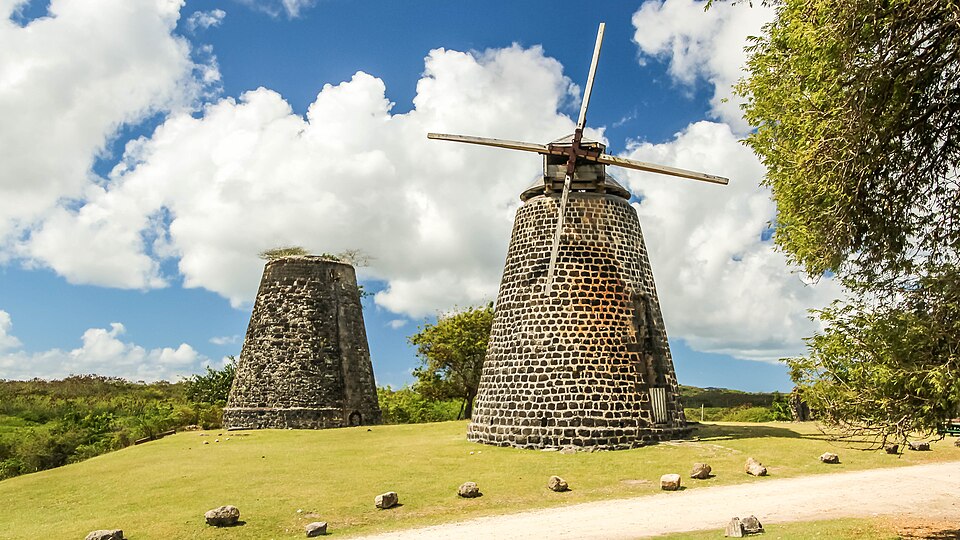
The twin stone windmill towers.
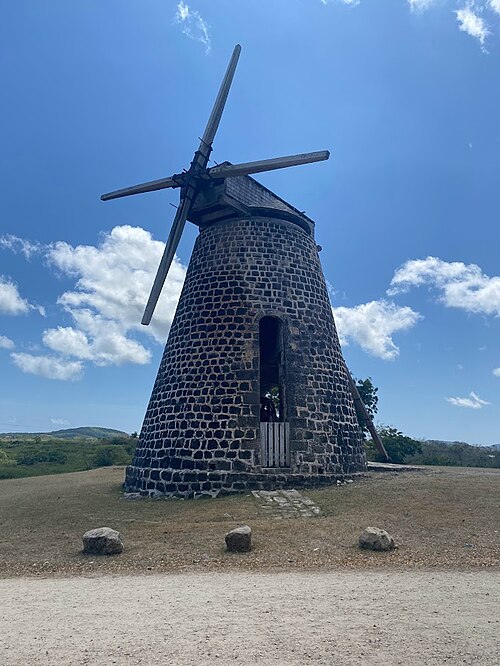
Betty's Hope was a sugarcane plantation in Diamonds, Antigua. It was established in 1650, shortly after the island had become an English colony, and flourished as a successful agricultural industrial enterprise during the centuries of slavery. It was the first large-scale sugar plantation to operate in Antigua and belonged to the Codrington family from 1674 until 1944. Christopher Codrington, later Captain General of the Leeward Islands, acquired the property in 1674 and named it Betty's Hope, after his daughter.
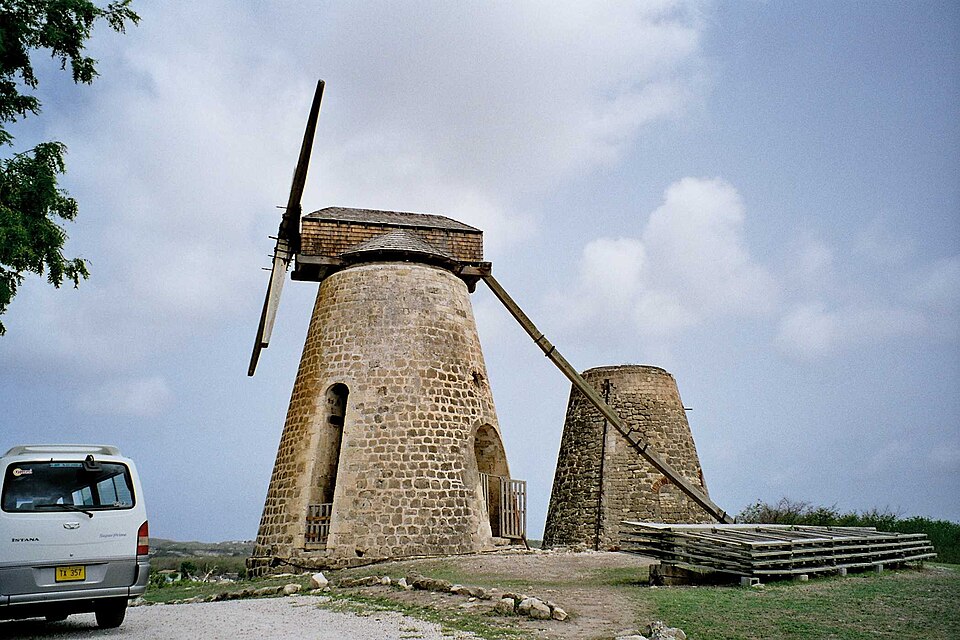
Betty's Hope is no longer operational as a plantation. However, the structures pictured here at the time of restoration works initiated by the Government of Antigua and Barbuda in 1990, under the OEC/ESDU Eco-Tourism Enhancement project, consisted of the twin windmills, the Cistern Complex in serviceable condition, the Great House (Buff or Estate House) in ruins, the Boiling House where sixteen copper hoppers were used to boil cane juice to produce crystalline sugar, and the Still House, a distillery used for manufacturing rum (also seen in ruins without a roof but with elegant arches). Since 1995, the buildings have been developed as an open-air museum with a visitor center and are managed by the Museum of Antigua and Barbuda. The museum has designated the site as a Historical Site of Antigua and Barbuda.
Further reading
- Sugar and slaves · Richard S. Dunn (1972)Richard Dunn's history of the sugar planters and slavery in the West Indies, including sugar manufacture and plantation life.Find a copy: AbeBooks · Amazon · WorldCat
- Bondmen & rebels · David Barry Gaspar (1985)A history of slavery, slaves and slave insurrections in Antigua and Barbuda.Find a copy: AbeBooks · Amazon · WorldCat
Betty's Hope Windmill is one of the 3D puzzles in World Artifacts: turn a cloud of broken pieces until it lines up. For iPhone, iPad, Apple Vision Pro and Android.

