World Artifacts › Atlas › Austria
Hallstatt Salt Miner
The Iron Age culture across central Europe is named Hallstatt after this site, because the cemetery here defined the period. The miners' bodies and clothing have come out of the salt intact enough to show what they ate and how their backs were damaged.
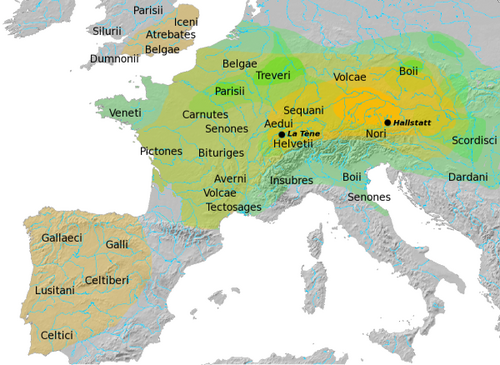
The Hallstatt culture was the predominant Western and Central European archaeological culture of the Late Bronze Age from the 12th to 8th centuries BC (Hallstatt A, Hallstatt B) and Early Iron Age Europe from the 8th to 6th centuries BC (Hallstatt C, Hallstatt D), developing out of the Urnfield culture of the 12th century BC (Late Bronze Age) and followed in much of its area by the La Tène culture. It is commonly associated with Proto-Celtic speaking populations.
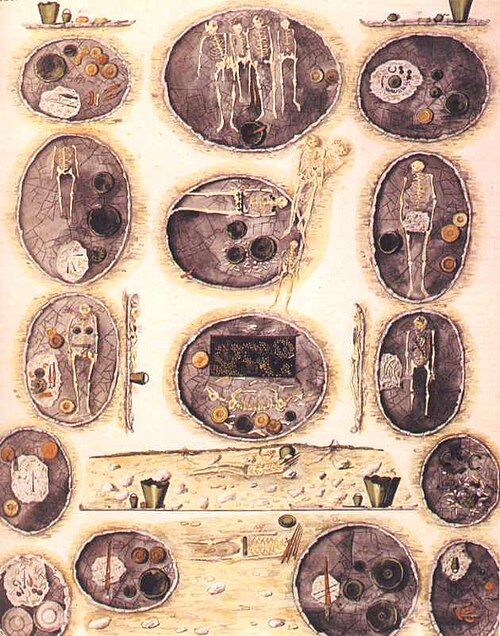
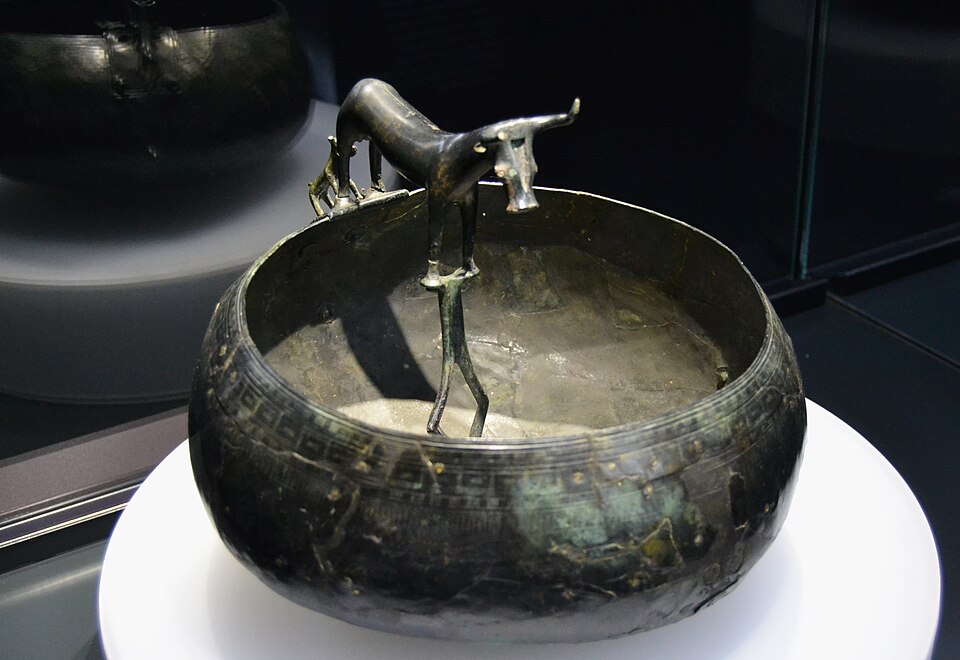
It is named for its type site, Hallstatt, a lakeside village in the Austrian Salzkammergut southeast of Salzburg, where there was a rich salt mine, and some 1,300 burials are known, many with fine artifacts. Material from Hallstatt has been classified into four periods, designated "Hallstatt A" to "D". Hallstatt A and B are regarded as Late Bronze Age with later Iron Age Hallstatt C and D more generalised under widely encompassing terms such as "Hallstatt culture", or "period", "style" and so on.
By the 6th century BC, it had expanded to include wide territories, falling into two zones, east and west, between them covering much of western and central Europe down to the Alps, and extending into northern Italy. Parts of Britain and Iberia are included in the ultimate expansion of the culture.
Further reading
- The Ancient Celts · Barry W. Cunliffe (2000)A history of the Celts of Iron Age central and western Europe, using archaeology.Find a copy: AbeBooks · Amazon · WorldCat
- Oxford Handbook of the European Iron Age · Colin Haselgrove (2023)Handbook on Iron Age Europe covering archaeology, settlement, economy, society and burial.Find a copy: AbeBooks · Amazon · WorldCat
Hallstatt Salt Miner is one of the 3D puzzles in World Artifacts: turn a cloud of broken pieces until it lines up. For iPhone, iPad, Apple Vision Pro and Android.

