World Artifacts › Atlas › Belgium
Mercator's Globe
Mercator's projection distorts everything towards the poles, which is its cost and not its purpose. Its virtue is that a straight line drawn on it is a constant compass bearing, which is exactly what a sailor needs and nothing else provides.
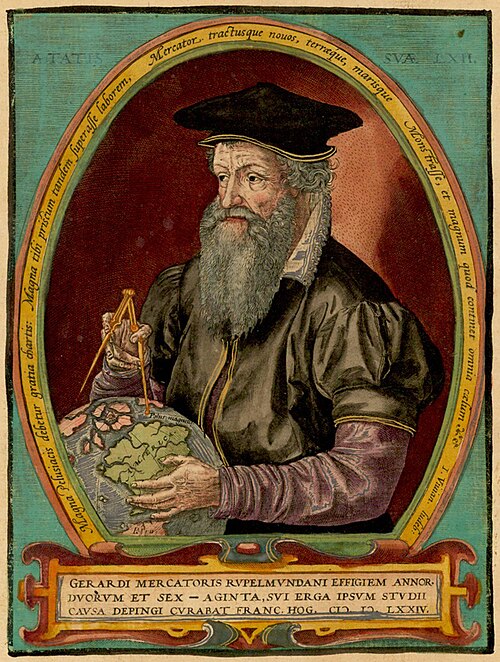
Gerardus Mercator (; 5 March 1512 - 2 December 1594) was a Flemish geographer, cosmographer and cartographer. He is most renowned for creating the 1569 world map based on a new projection which represented sailing courses of constant bearing (rhumb lines) as straight lines - an innovation that is still employed in nautical charts.
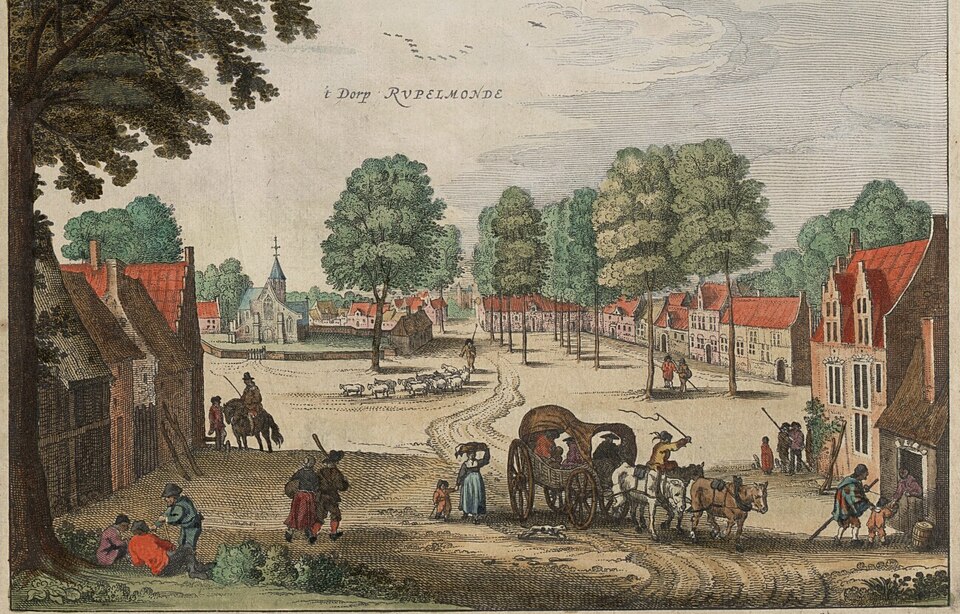
Mercator was a notable maker of globes and scientific instruments. In addition, he had interests in theology, philosophy, history, mathematics, and geomagnetism. He was also an accomplished engraver and calligrapher. Unlike other great scholars of the age, he travelled little and his knowledge of geography came from his library of over a thousand books and maps, from his visitors and from his vast correspondence (in six languages) with other scholars, statesmen, travellers, merchants and seamen. Mercator's early maps were in large formats suitable for wall mounting but in the second half of his life, he produced over 100 new regional maps in a smaller format suitable for binding into his Atlas of 1595. This was the first appearance of the word "atlas" in connection with maps, but Mercator did not intend the word to mean a collection of maps; it was a neologism for a treatise (Cosmologia) on the creation, history and description of the universe. He chose the word as a reference to a legendary king of Mauretania who was traditionally considered the first great geographer.
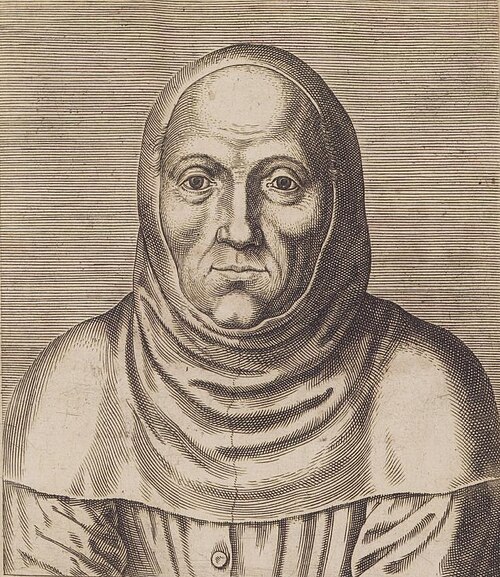
Further reading
- Mercator · Nicholas Crane (2002)Biography of Gerhard Mercator, cartographer, and the history of his cartography.Find a copy: AbeBooks · Amazon · WorldCat
- Rhumb Lines and Map Wars · Mark Monmonier (2004)Covers the Mercator projection, loxodromes and navigation, and the debates over map projections.Find a copy: AbeBooks · Amazon · WorldCat
Mercator's Globe is one of the 3D puzzles in World Artifacts: turn a cloud of broken pieces until it lines up. For iPhone, iPad, Apple Vision Pro and Android.

