World Artifacts › Atlas › Canada
Hopewell Rocks
The Bay of Fundy has the highest tides in the world, up to sixteen metres, and the rocks are undercut by them twice a day. You can walk on the sea floor around their bases in the morning and kayak over the same spot in the afternoon.
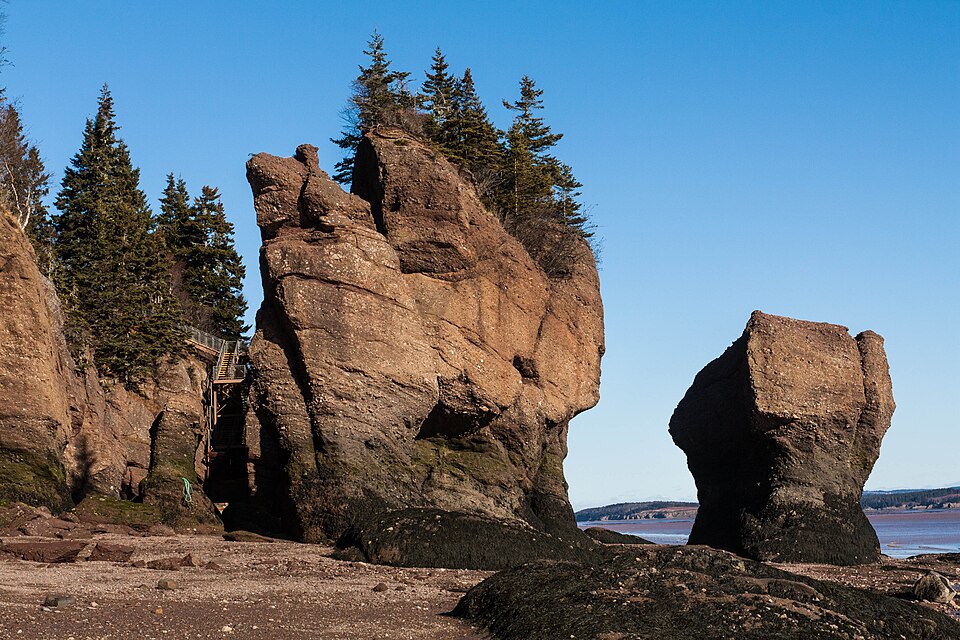
The Hopewell Rocks, also called the Flowerpot Rocks or simply the Rocks, are rock formations known as sea stacks caused by tidal erosion in the Hopewell Rocks Ocean Tidal Exploration Site at the Hopewell Rocks Provincial Park in New Brunswick, Canada. They stand 12-21 metres (40-70 ft) tall.
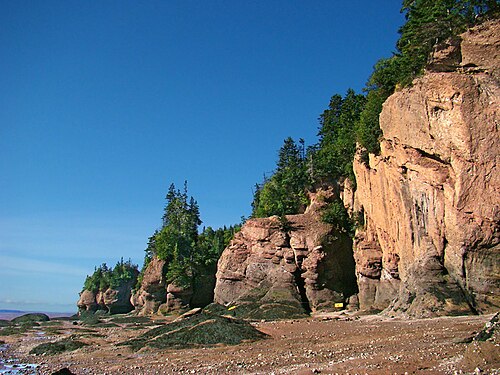
They are located on the shores of the upper reaches of the Bay of Fundy at Hopewell Cape near the end of a series of Fundy coastal tourism hubs including Fundy National Park and the Fundy Trail. Due to the extreme tidal range of the Bay of Fundy, the base of the formations are covered in water twice a day. It is possible to view the formations from ground level at low tide.
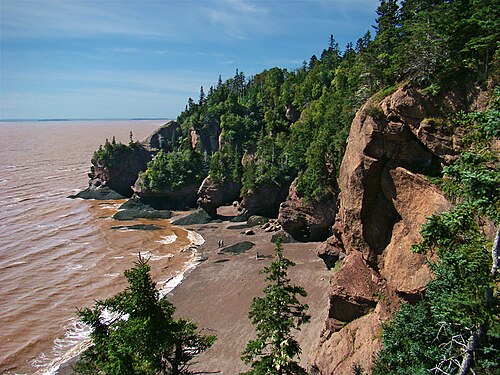
The formations consist of red-brown sedimentary conglomerate, sandstone, and minor mudstone rock from the Carboniferous Hopewell Cape Formation, part of the Mabou Group. The large volume of water flowing in to and out of the Bay of Fundy modifies the landscape surrounding it. After the retreat of the glaciers in the region following the last ice age, surface water filtering through cracks in the cliff has eroded and separated the formations from the rest of the cliff face. Meanwhile, advancing and retreating tides and the associated waves have eroded the base of the rocks at a faster rate than the tops, resulting in their unusual shapes.
The vast sediment planes in the basin in Fundy supports a variety of biological productivity. Various shorebirds are often seen flocking
Hopewell Rocks is one of the 3D puzzles in World Artifacts: turn a cloud of broken pieces until it lines up. For iPhone, iPad, Apple Vision Pro and Android.

