World Artifacts › Atlas › Canada
Voyageur Sash
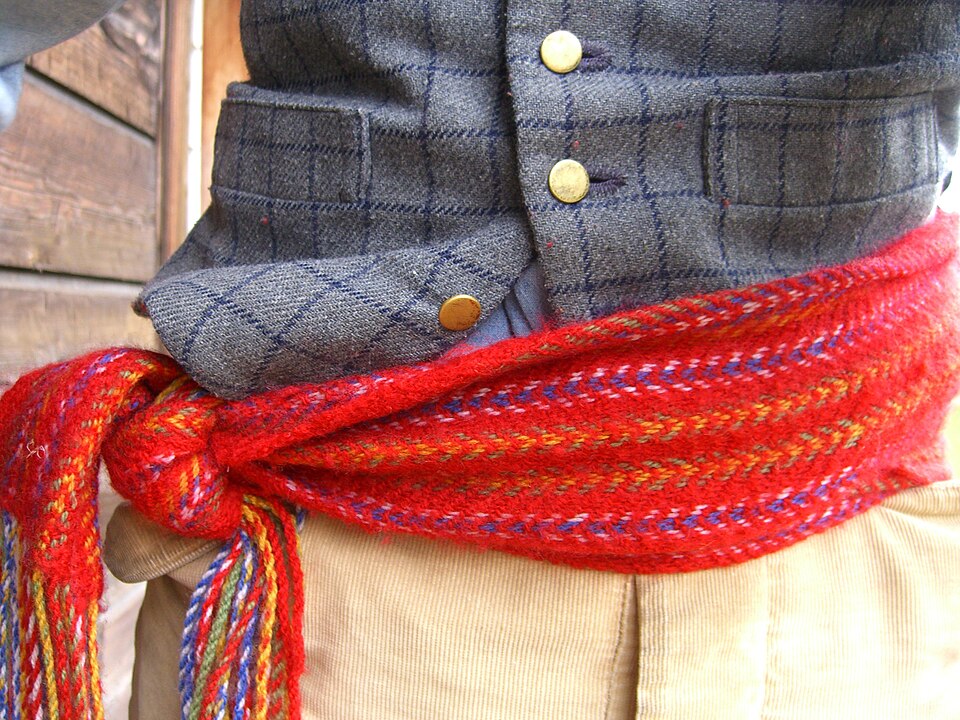
The voyageur's sash is finger-woven, several metres long, and did real work: it held the coat closed, carried a knife and a pipe, and supported the back under a load of ninety kilos. The arrow pattern is Quebecois and the technique is older.
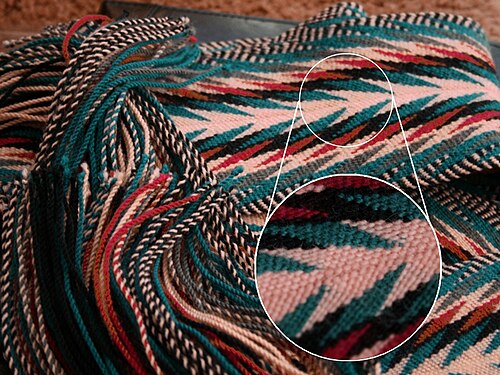
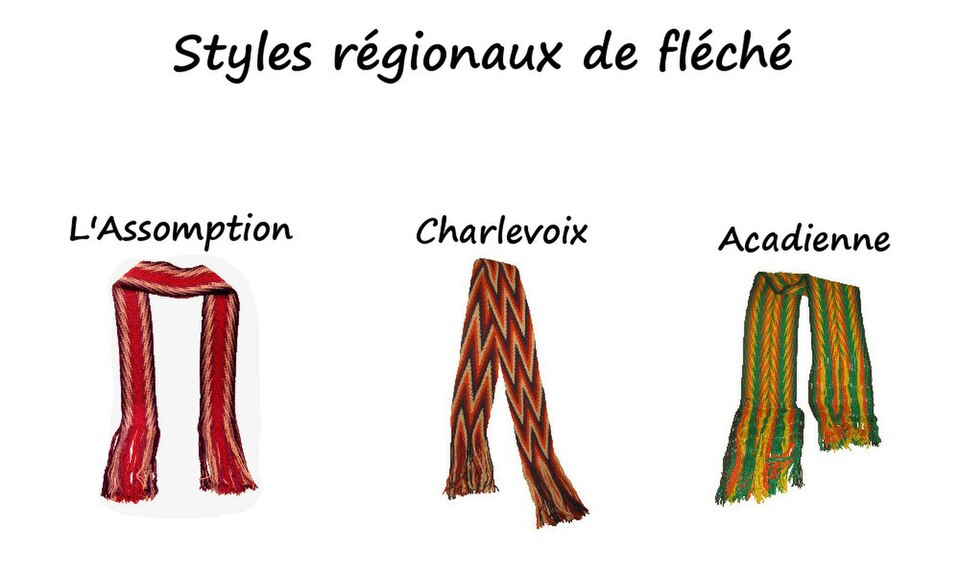
The ceinture fléchée [sɛ̃tyʁ fleʃe] (French, 'arrowed sash') or ('arrow sash') is a type of colourful sash, a traditional piece of Québécois clothing linked to at least the 17th century (of the Lower Canada, Canada East and early confederation eras). The Métis also adopted and made ceintures fléchées (French-Canadian and later Metis or Michif translation: "Sayncheur Flayshii" or "Saenche(i)ur Flechey") and use them as part of their national regalia. Québécois and Métis communities share the sash as an important part of their distinct cultural heritages, nationalities, attires, histories and resistances. While the traditional view is that the ceinture fléchée is a Québécois invention, other origins have been suggested as well including the traditional fingerwoven Gaelic crios. According to Dorothy K. Burnham who prepared an exhibit on textiles at the National Gallery of Canada in 1981, and published an accompanying catalogue raisonné, this type of finger weaving was learned by residents of New France from Indigenous peoples. With European wool-materials, the syncretism and unification of Northern French and Indigenous finger-weaving techniques resulted in the making of Arrowed Sashes. The Arrow Sash pattern is the oldest known sash design; it was produced by Québécois artisans in 18th century. The Assomption pattern was produced after 1852.
Further reading
Voyageur Sash is one of the 3D puzzles in World Artifacts: turn a cloud of broken pieces until it lines up. For iPhone, iPad, Apple Vision Pro and Android.

