World Artifacts › Atlas › China
Marble Boat
The marble boat cannot move, and it was rebuilt with money that had been raised for a modern navy. Ten years later the real fleet was destroyed by Japan, and the boat has been an emblem of the wrong priorities ever since.
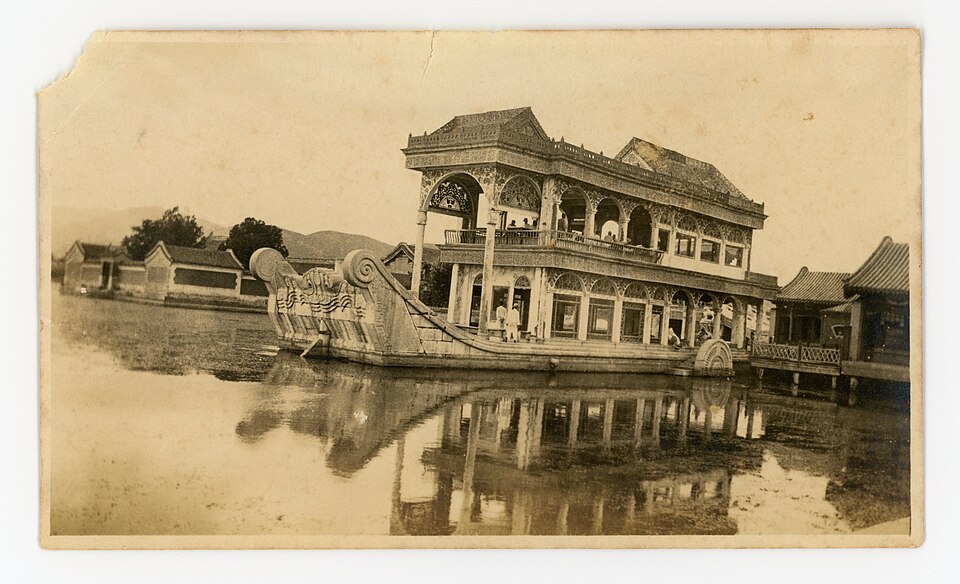
The Marble Boat (Chinese: 石舫; pinyin: Shí Fǎng), also known as the Boat of Purity and Ease, is a lakeside pavilion on the grounds of the Summer Palace in Beijing, China.
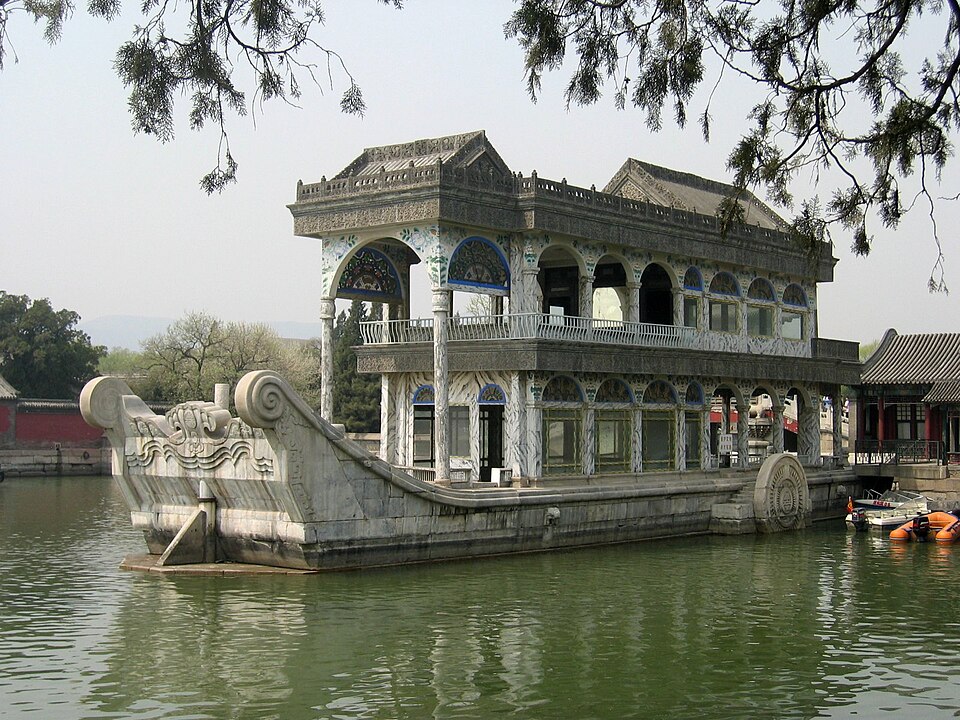
It was first erected in 1755 during the reign of the Qianlong Emperor. The original pavilion was made from a base of large stone blocks which supported a wooden superstructure done in a traditional Chinese design.
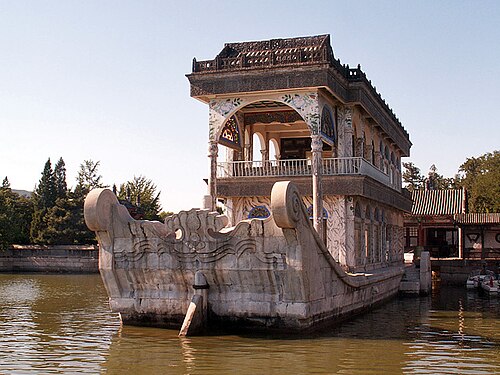
In 1860, during the Second Opium War, the pavilion was burnt on the orders of Lord Elgin. It was restored in 1893 on order of Empress Dowager Cixi. In this restoration, a new two-story superstructure was designed which incorporated elements of European architecture. Like its predecessor, the new superstructure is made out of wood but it was painted to imitate marble. On each "deck", there is a large mirror to reflect the waters of the lake and give an impression of total immersion in the aquatic environment. Imitation paddlewheels on each side of the pavilion make it look like a paddle steamer.
The pavilion has a sophisticated drainage system which channels rainwater through four hollow pillars, which is finally released into the lake through the mouths of four dragonheads.
Further reading
- Empress Dowager Cixi · Jung Chang (2013)Biography of Empress Dowager Cixi, covering Qing politics, government and foreign relations in 19th-century China.Find a copy: AbeBooks · Amazon · WorldCat
- Dragon Lady · Sterling Seagrave (1992)A biography of Cixi, the empress dowager of China.Find a copy: AbeBooks · Amazon · WorldCat
Marble Boat is one of the 3D puzzles in World Artifacts: turn a cloud of broken pieces until it lines up. For iPhone, iPad, Apple Vision Pro and Android.

