World Artifacts › Atlas › China
Rice Bowl and Chopsticks
Chopsticks are never stood upright in a bowl of rice, because that is how incense is offered to the dead. The knife stays in the kitchen: cutting at the table was thought to belong to the butcher, not to the guest.
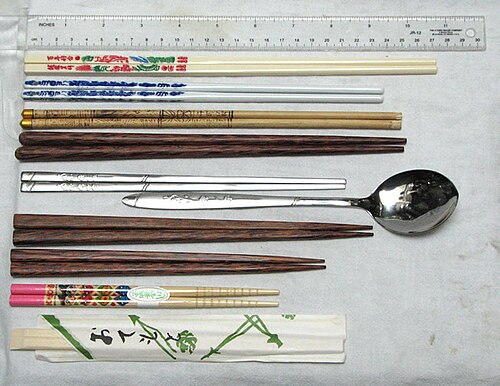
Chopsticks are shaped pairs of equal-length sticks that have been used as kitchen and eating utensils in most countries of the Sinosphere for over three millennia. They are held in the dominant hand, secured by fingers, and wielded as extensions of the hand, to pick up food.
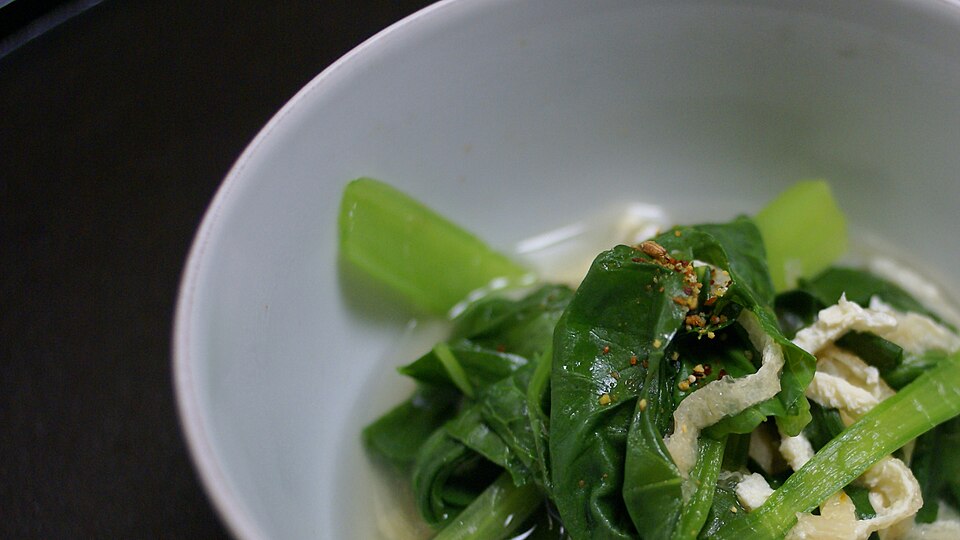
Originating in China, chopsticks later spread to other parts of the Sinosphere such as Korea, Japan and Vietnam. Chopsticks have become more accepted in connection with East Asian food in the West, especially in cities with significant East Asian diaspora communities.
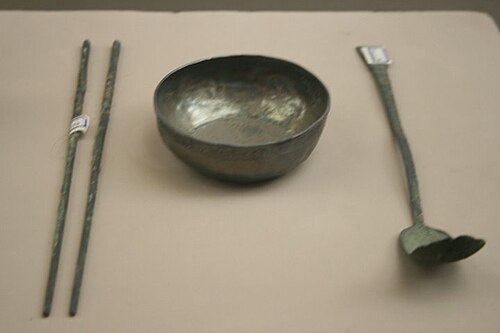
Chopsticks are smoothed, and frequently tapered. They are traditionally made of wood, bamboo, metal, ivory, and ceramics, and in modern days, increasingly available in non-traditional materials such as plastic, stainless steel, and even titanium. Chopsticks are often seen as requiring practice and skill to master to be used as an eating utensil. In some countries, failing to follow etiquette in their use is frowned upon, though such feelings are generally lesser than they once were.
Further reading
Rice Bowl and Chopsticks is one of the 3D puzzles in World Artifacts: turn a cloud of broken pieces until it lines up. For iPhone, iPad, Apple Vision Pro and Android.

