World Artifacts › Atlas › Colombia
Cup of Coffee
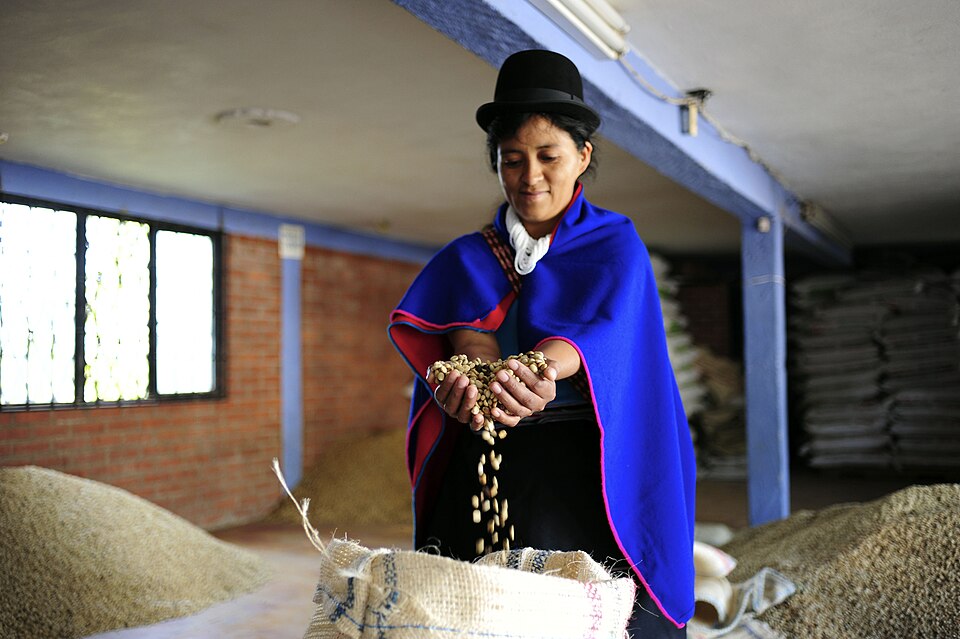
Colombian law permits only arabica to be grown, and only washed and sun-dried, which is a quality rule enforced at national level. The coffee grows on smallholdings averaging under two hectares, so the country's most famous export is made by hundreds of thousands of families.
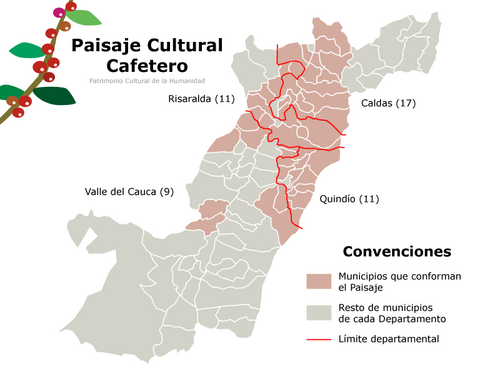
Coffee production in Colombia has a reputation for producing mild, well-balanced coffee beans. Colombia's average annual coffee production of 11.5 million bags is the third total highest in the world, after Brazil and Vietnam, though highest in terms of the arabica bean. The beans are exported to the United States, Germany, France, Japan, and Italy. Most coffee is grown in the Colombian coffee growing axis region, while other regions focus on quality instead of volumes, such as Sierra Nevada de Santa Marta. In 2007, the European Union granted Colombian coffee a protected designation of origin status. In 2011, UNESCO declared the "Coffee Cultural Landscape" of Colombia a World Heritage Site.

The coffee plant had spread to Colombia by 1790. The oldest written testimony of the presence of coffee in Colombia is attributed to a Jesuit priest, José Gumilla. In his book The Orinoco Illustrated (1730), he registered the presence of coffee in the mission of Saint Teresa of Tabajé, near where the Meta river empties into the Orinoco. Further testimony comes from the archbishop-viceroy Caballero y Gongora (1787) who registered the presence of the crop in the north east of the country near Giron (Santander) and Muzo (Boyaca) in a report that he provided to the Spanish authorities.
Further reading
- Coffee and conflict in Colombia, 1886-1910 · Charles W. Bergquist (1978)A history of Colombia's coffee industry and its politics and economy, 1886-1910.Find a copy: AbeBooks · Amazon · WorldCat
- Uncommon grounds · Mark Pendergrast (1999)A history of coffee and the coffee industry worldwide.Find a copy: AbeBooks · Amazon · WorldCat
Cup of Coffee is one of the 3D puzzles in World Artifacts: turn a cloud of broken pieces until it lines up. For iPhone, iPad, Apple Vision Pro and Android.

