World Artifacts › Atlas › Germany
Meissen Porcelain Figure
An alchemist was locked up by the Elector of Saxony and told to produce gold. He produced the first hard-paste porcelain in Europe instead, which was worth more, and the crossed swords mark has been used ever since.
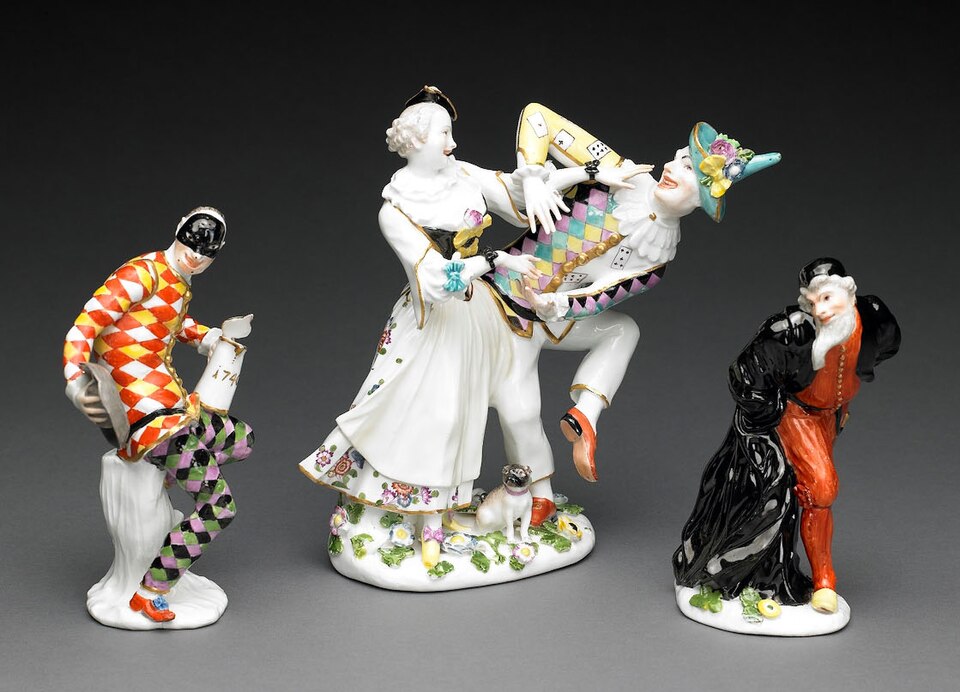
Meissen porcelain, or Meissen china, was the first European hard-paste porcelain. Early experiments were done in 1708 by Ehrenfried Walther von Tschirnhaus. After his death that October, Johann Friedrich Böttger continued von Tschirnhaus's work and brought this type of porcelain to the market, financed by Augustus the Strong, King of Poland and Elector of Saxony. The production of porcelain in the royal factory at Meissen, near Dresden, started in 1710 and attracted artists and artisans to establish, arguably, the most famous porcelain manufacturer known throughout the world. Its signature logo, the crossed swords, was introduced in 1720 to protect its production; the mark of the swords is reportedly one of the oldest trademarks in existence.
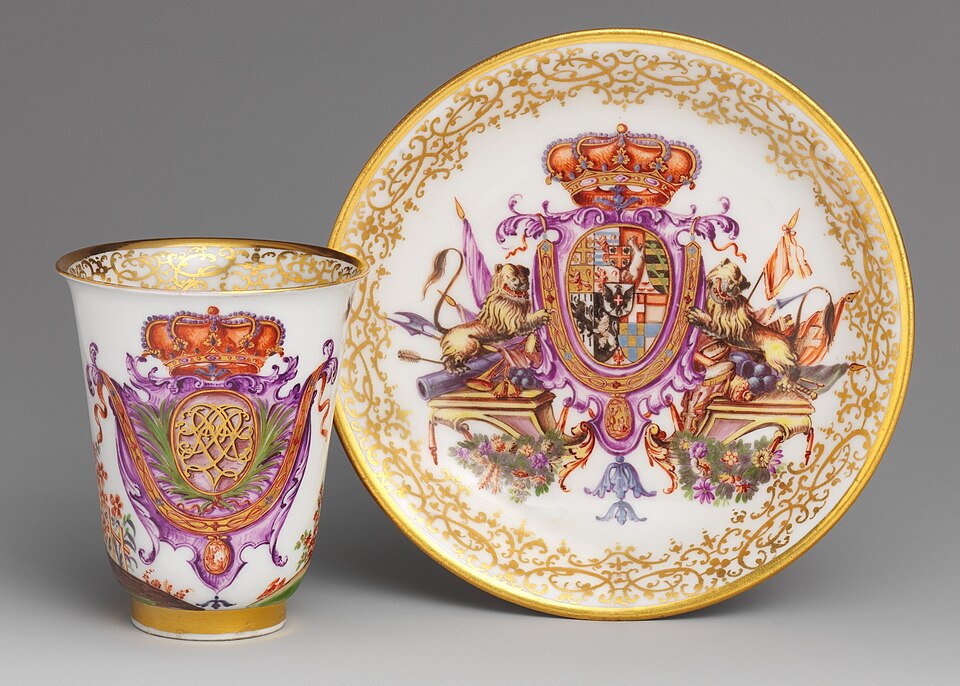
Dresden porcelain (or "china") was once the usual term for these wares, until in 1975 the Oberlandesgericht (Higher Munich State Court) decided in favour of the Saxon Porcelain Manufactory Dresden, which alone was then allowed to use the name Dresden Porcelain (it ceased producing in 2020).

Meissen remained the dominant European porcelain factory, and the leader of stylistic innovation, until somewhat overtaken by the new styles introduced by the French Sèvres factory in the 1760s, but has remained a leading factory to the present day. Among the developments pioneered by Meissen are the porcelain figurines, and the introduction of European decorative styles to replace the imitation of Asian decoration of its earliest wares.
Further reading
- The arcanum · Janet Gleeson (1999)Tells the story of how European hard-paste porcelain came to be made at Meissen, beginning with the quest for gold.Find a copy: AbeBooks · Amazon · WorldCat
- Early Meissen Porcelain · Michael Greenberger (2019)A study of early Meissen porcelain.Find a copy: AbeBooks · Amazon · WorldCat
Meissen Porcelain Figure is one of the 3D puzzles in World Artifacts: turn a cloud of broken pieces until it lines up. For iPhone, iPad, Apple Vision Pro and Android.

