World Artifacts › Atlas › Germany
Pied Piper
The town chronicle records, in 1284, that a hundred and thirty children were lost from Hameln, and gives no explanation. The rats were added to the story three centuries later, which suggests the original was about something worse.

The Pied Piper of Hamelin (German: der Rattenfänger von Hameln), also known as the Pan Piper or the Rat-Catcher of Hamelin, is the title character of a legend from the town of Hamelin (Hameln), Lower Saxony, Germany. It involves a singular, unknown man who charms dozens of children out of their homes and vanishes with them.
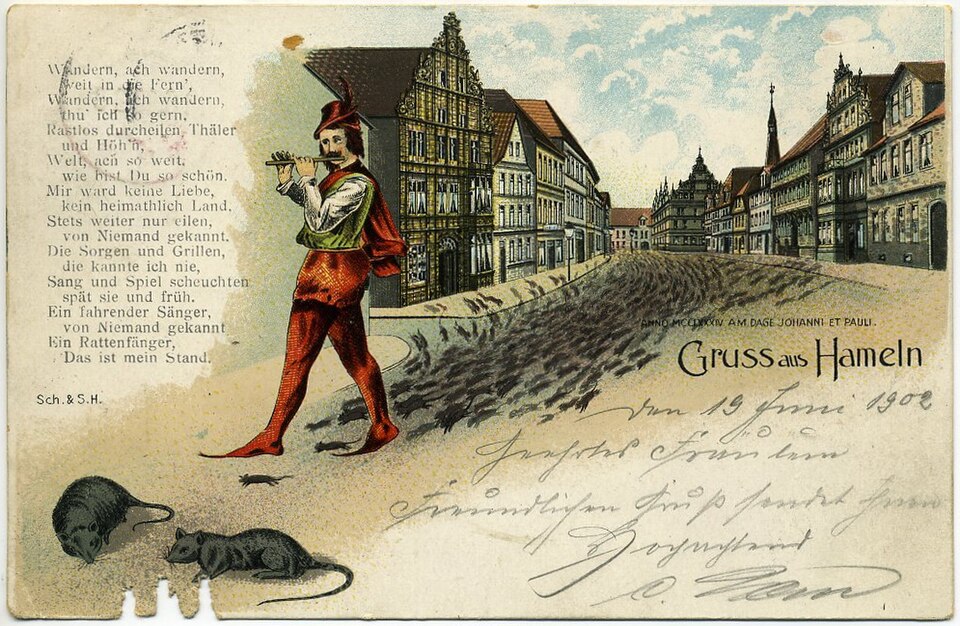
The legend dates back to the Middle Ages. The earliest references describe a piper, dressed in multicoloured ("pied") clothing, who was a rat catcher hired by the town to lure rats away with his magic pipe. When the citizens refused to pay for this service as promised, he retaliated by using his instrument's magical power on their children, leading them away as he had the rats. This version of the story spread as folklore and has appeared in the writings of Johann Wolfgang von Goethe, the Brothers Grimm, and Robert Browning, among others. The phrase "pied piper" has become a metaphor for a person who attracts a following through charisma or false promises.

Various theories have arisen about the origin and symbolism of the Pied Piper. Some suggest he was a symbol of hope to the people of Hamelin, which had been subjected to plague; he drew the rats from Hamelin, saving the people from the epidemic.
Further reading
Pied Piper is one of the 3D puzzles in World Artifacts: turn a cloud of broken pieces until it lines up. For iPhone, iPad, Apple Vision Pro and Android.

