World Artifacts › Atlas › Egypt
Hatshepsut's Temple
Hatshepsut ruled as king rather than queen and had herself shown with a false beard, because there was no royal image for a woman. Her successor had her name chiselled out of the monuments decades after her death.
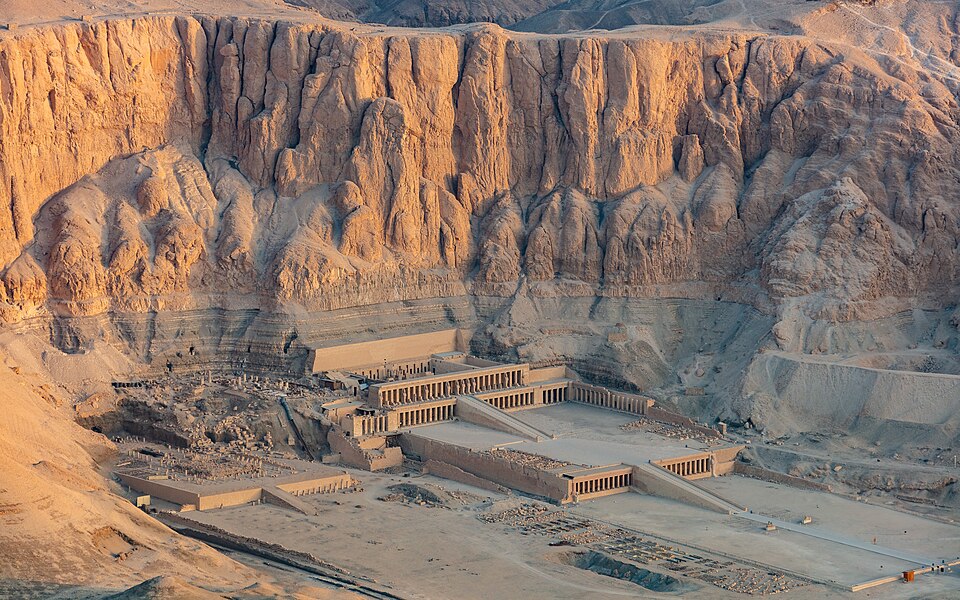
The mortuary temple of Hatshepsut (Egyptian: Ḏsr-ḏsrw, lit. 'Holy of Holies') was built during the reign of Pharaoh Hatshepsut of the Eighteenth Dynasty of Egypt. Located opposite the city of Luxor, it is considered to be a masterpiece of ancient architecture. Its three massive terraces rise above the desert floor and into the cliffs of Deir el-Bahari. Hatshepsut's tomb, KV20, lies inside the same massif capped by El Qurn, a pyramid for her mortuary complex. At the edge of the desert, 1 km (0.62 mi) east, connected to the complex by a causeway, lies the accompanying valley temple. Across the river Nile, the whole structure points towards the monumental Eighth Pylon, Hatshepsut's most recognizable addition to the Temple of Karnak and the site from which the procession of the Beautiful Festival of the Valley departed. Its axes identify the temple's twin functions: Its central east-west axis served to receive the barque of Amun-Re at the climax of the festival, while its north-south axis represented the life cycle of the pharaoh from coronation to rebirth.
Further reading
- The Temple of Deir el Bahari · Edouard Naville (2012)Edouard Naville's work on the Temple of Deir el Bahari.Find a copy: AbeBooks · Amazon · WorldCat
- The Woman Who Would Be King · Kara Cooney (2014)A biography of Hatshepsut, the woman who ruled ancient Egypt as pharaoh.Find a copy: AbeBooks · Amazon · WorldCat
Hatshepsut's Temple is one of the 3D puzzles in World Artifacts: turn a cloud of broken pieces until it lines up. For iPhone, iPad, Apple Vision Pro and Android.

