World Artifacts › Atlas › Egypt
White Desert Rock
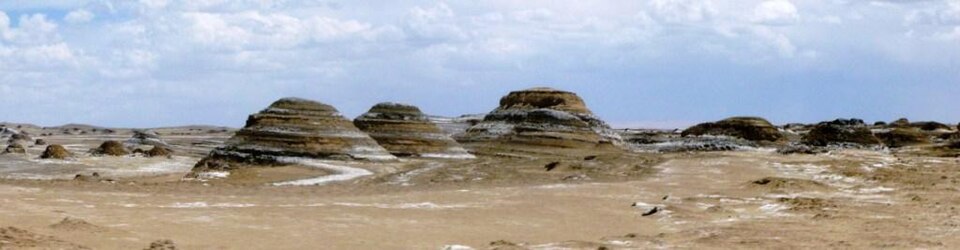
The chalk shapes are wind sculpture: sand carried near the ground cuts the base of each rock faster than the top, so they are eaten into mushrooms and left standing on stalks.
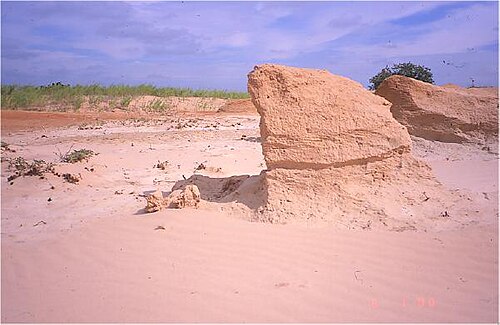
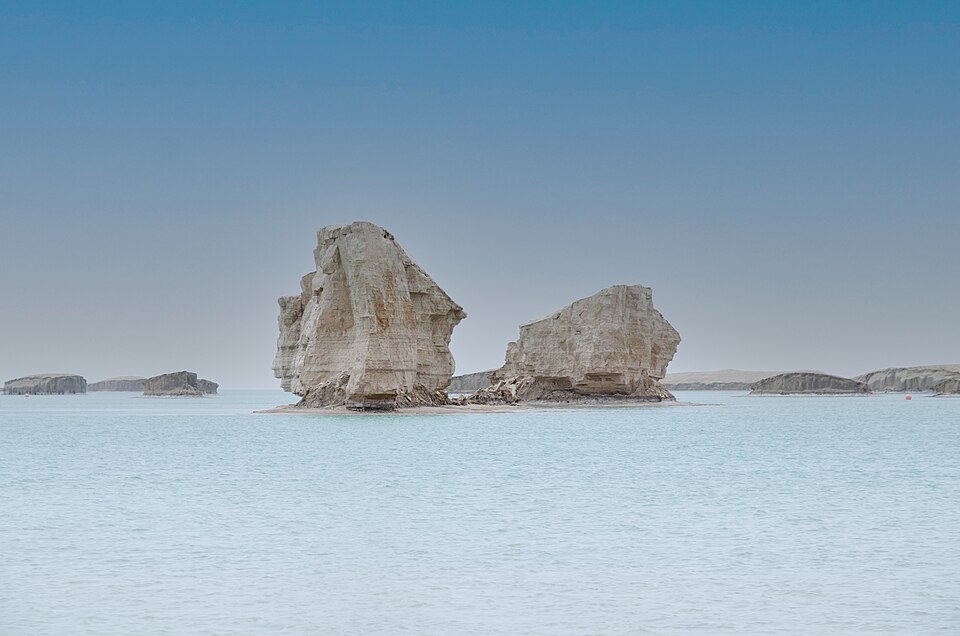
A yardang is a streamlined protuberance carved from bedrock or any consolidated or semiconsolidated material by the dual action of wind abrasion by dust and sand and deflation (the removal of loose material by wind turbulence). Yardangs become elongated features typically three or more times longer than wide, and when viewed from above, resemble the hull of a boat. Facing the wind is a steep, blunt face that gradually gets lower and narrower toward the lee end. Yardangs are formed by wind erosion, typically of an originally flat surface formed from areas of harder and softer material. The soft material is eroded and removed by the wind, and the harder material remains. The resulting pattern of yardangs is therefore a combination of the original rock distribution, and the fluid mechanics of the air flow and resulting pattern of erosion.
Further reading
- Desert Geomorphology · Andrew Warren (2006)A study of desert geomorphology, the landforms shaped in deserts.Find a copy: AbeBooks · Amazon · WorldCat
- The physics of blown sand and desert dunes · Ralph A. Bagnold (1941)Covers wind, blown sand, wind erosion and dunes.Find a copy: AbeBooks · Amazon · WorldCat
White Desert Rock is one of the 3D puzzles in World Artifacts: turn a cloud of broken pieces until it lines up. For iPhone, iPad, Apple Vision Pro and Android.

