World Artifacts › Atlas › United Kingdom
Forth Bridge
The bridge was built after a lighter design collapsed in a storm and killed a trainload of people, so it was made deliberately, visibly over-strong. The idea that painting it never ends is a good story but the modern coating lasts about twenty years.
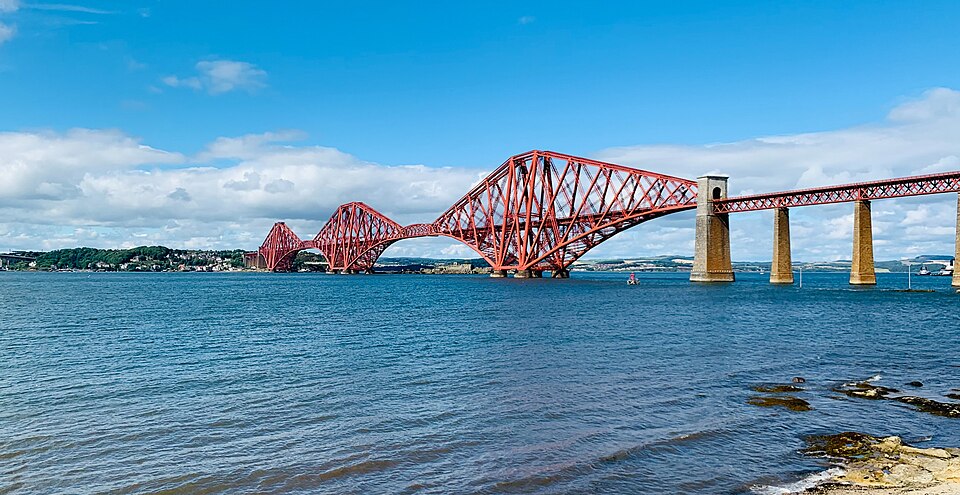
The Forth Bridge is a cantilever railway bridge across the Firth of Forth in the east of Scotland, 9 miles (14 kilometres) west of central Edinburgh. Completed in 1890, it is considered a symbol of Scotland (having been voted Scotland's greatest man-made wonder in 2016), and is a UNESCO World Heritage Site. It was designed by English engineers Sir John Fowler and Sir Benjamin Baker. It is sometimes referred to as the Forth Rail Bridge (to distinguish it from the adjacent Forth Road Bridge), although this is not its official name.
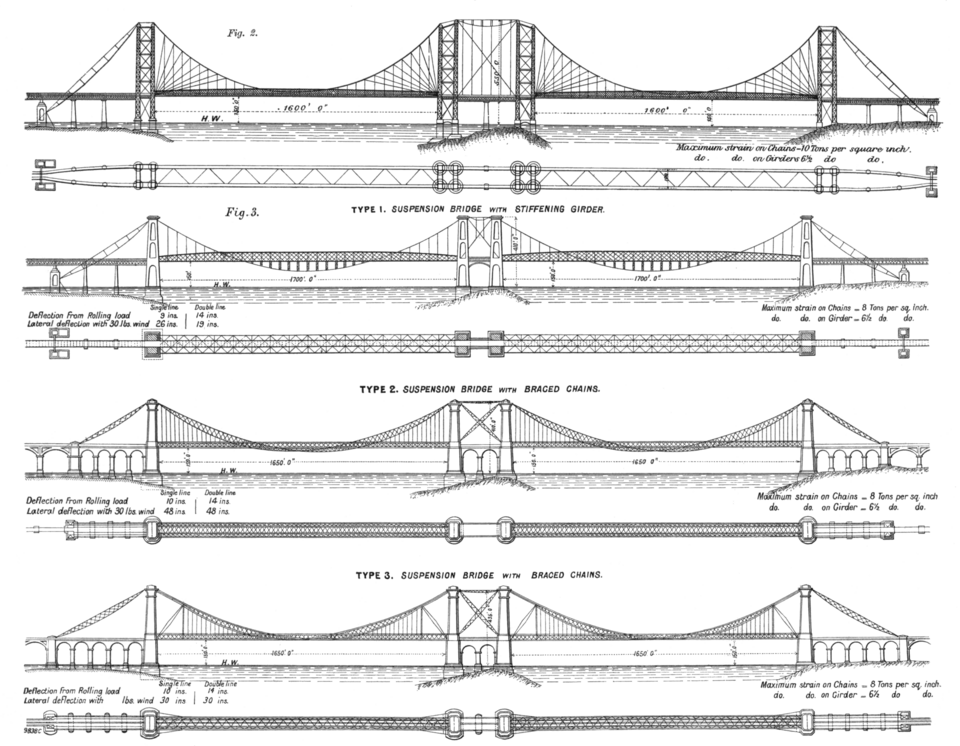
Construction of the bridge began in 1882 and it was opened on 4 March 1890 by the Duke of Rothesay, the future Edward VII. The bridge carries the Edinburgh-Aberdeen line across the Forth between the villages of South Queensferry and North Queensferry and has a total length of 2,467 metres (8,094 ft). When it opened it had the longest single cantilever bridge span in the world, until 1919 when the single 1,801 ft (549 m) span Quebec Bridge in Canada was completed. It continues to be the world's second-longest single cantilever span, with two spans of 1,709 feet (521 m).
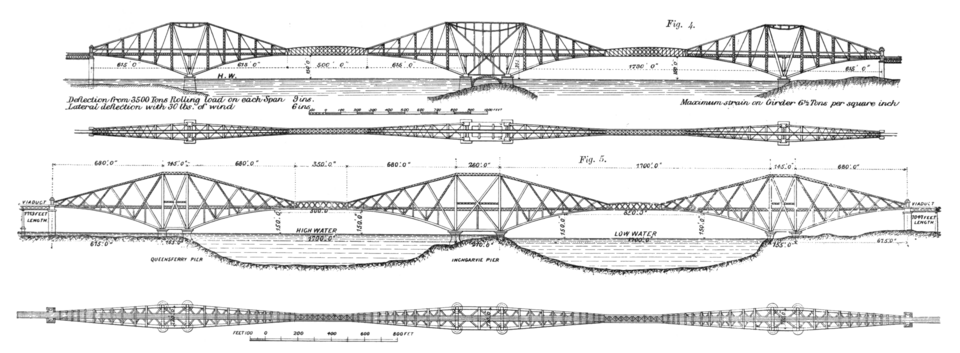
The bridge and its associated railway infrastructure are owned by Network Rail.
Further reading
- The Forth Bridge · W. Westhofen (1890)A book on the Forth Bridge itself, covering its design as a cantilever bridge.Find a copy: AbeBooks · Amazon · WorldCat
- The high girders · Prebble, John (1956)An account of the Tay Bridge disaster of 1879, the collapse behind the push for a stronger bridge.Find a copy: AbeBooks · Amazon · WorldCat
Forth Bridge is one of the 3D puzzles in World Artifacts: turn a cloud of broken pieces until it lines up. For iPhone, iPad, Apple Vision Pro and Android.

