World Artifacts › Atlas › Greece
Greek Flag
The nine stripes are usually explained as the nine syllables of the Greek for freedom or death, the cry of the war of independence. The cross in the corner stands for the Orthodox church that held the language together under Ottoman rule.
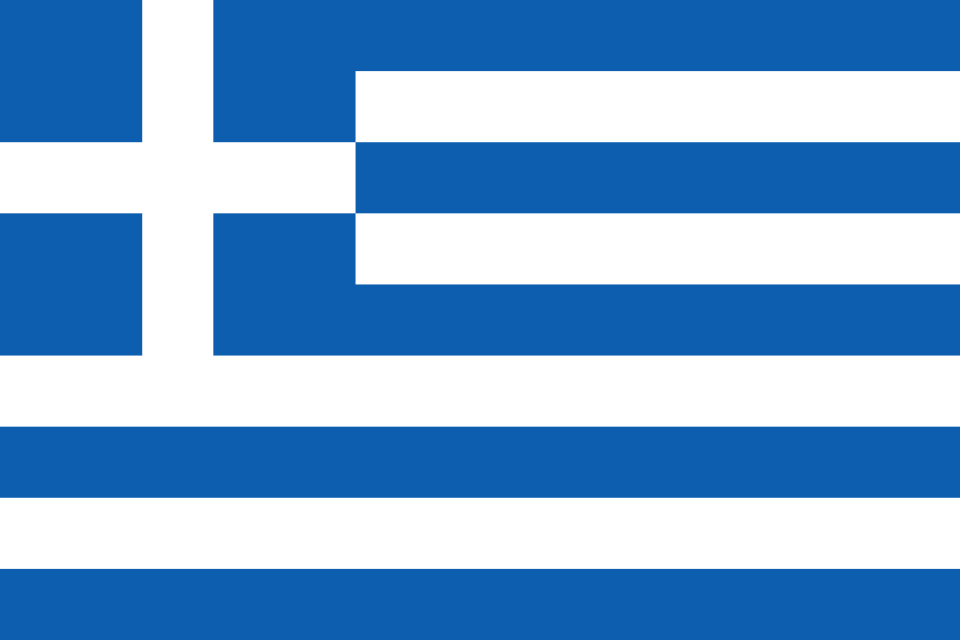
The national flag of Greece, popularly referred to as the Blue-and-White (Γαλανόλευκη, Galanólefki) or the Cyan-and-White (Κυανόλευκη, Kyanólefki), is officially recognised by Greece as one of its national symbols and has 9 horizontal stripes of alternating blue and white. There is a blue canton in the upper hoist-side corner bearing a white cross; the cross symbolises Christianity. The blazon of the flag is azure, four bars argent; on a canton of the field a Greek cross throughout of the second. The shade of blue used in the flag has varied throughout its history, from light blue to dark blue, the latter being increasingly used since the late 1960s. It was officially adopted by the First National Assembly at Epidaurus on 13 January 1822.
While the nine stripes do not have any official meaning, the most popular interpretation says that they represent the syllables of the phrase Ελευθερία ή Θάνατος (Freedom or Death): the five blue stripes for the syllables in Ελευθερία, the four white for those of ή Θάνατος. White and blue might symbolize the colours of the Greek sky and sea.
Greek Flag is one of the 3D puzzles in World Artifacts: turn a cloud of broken pieces until it lines up. For iPhone, iPad, Apple Vision Pro and Android.

