World Artifacts › Atlas › Indonesia
Satay
Satay is Javanese and travelled with Indonesian cooks and migrants to the Netherlands, Suriname and South Africa. The skewers are traditionally the ribs of coconut palm leaves.
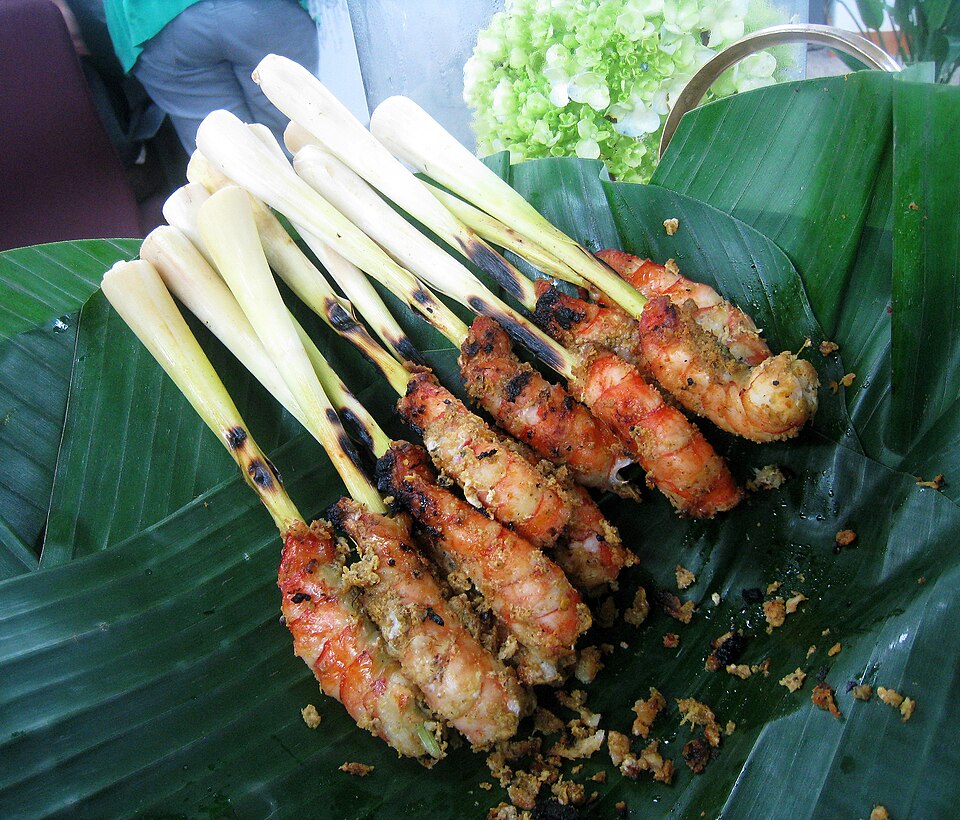
Satay or sate is a Southeast Asian dish consisting of small pieces of seasoned meat, seafood or vegetables skewered on sticks and grilled over charcoal. It is typically served with a sauce, most commonly peanut-based and accompanied by rice cakes, cucumber or pickled vegetables. Common ingredients include chicken, beef, goat, pork and seafood, while regional and vegetarian variations are also found.

The dish evolved through a blend of foreign and local culinary influences. Middle Eastern kebabs introduced by Muslim traders, South Asian cooking techniques brought by Tamil and Gujarati merchants, and Chinese practices such as bamboo skewering and bite-sized portions were adapted in the port cities of Java, Sumatra and the Malay Peninsula. Combined with the use of regional ingredients and spices including lemongrass, turmeric, galangal, and peanuts, these influences gave rise to a distinctly Southeast Asian style of grilled skewered meat.

Satay is widely consumed across Indonesia, Malaysia, Singapore, Brunei, Thailand and the southern Philippines, where it forms part of everyday meals, street food and festive occasions. Regional adaptations reflect local ingredients and cooking traditions, incorporating elements such as sweet soy sauce, coconut milk, turmeric and spice pastes, often served with ketupat, lontong or pickled condiments. The dish is prepared by hawkers, restaurants and home cooks alike, and has become a familiar feature of night markets and public celebrations.
Further reading
- Indonesian food and cookery · Sri Owen (1980)Sri Owen's book on Indonesian cookery, covering its dishes along with diet and social life and customs.Find a copy: AbeBooks · Amazon · WorldCat
- The food of Indonesia · Heinz von Holzen (1994)An Indonesian cookbook covering the food of Indonesia.Find a copy: AbeBooks · Amazon · WorldCat
Satay is one of the 3D puzzles in World Artifacts: turn a cloud of broken pieces until it lines up. For iPhone, iPad, Apple Vision Pro and Android.

