World Artifacts › Atlas › Iceland
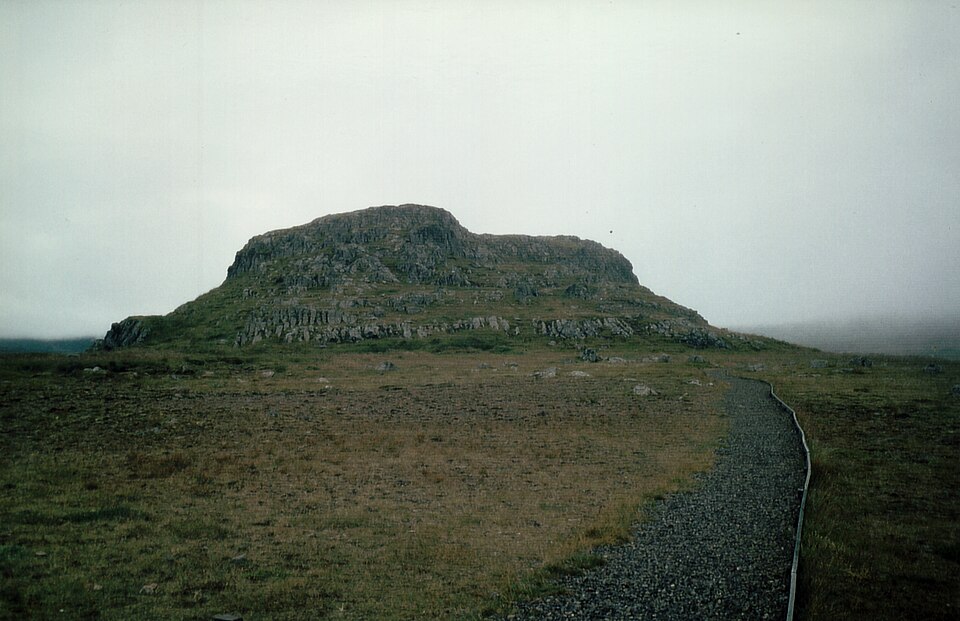
Elf Church Rock
Certain rocks are held to be elf churches or halls, and are left uncut when fields are cleared. Farmers have refused to move them for generations.
In Nordic folklore, including the Northern Isles, hidden-folk (Faroese and Icelandic: huldufólk; Norwegian: huldrefolk), mound-folk (Danish: højfolk, Swedish: högfolk), mountain-folk (Danish: bjærgfolk, Swedish: bergfolk, bergafolk; Finnish: vuoren väki), subterraneans (Norwegian: underjordiske, Swedish: underjordiska; Gutnish: di sma undar jordi, "the small underground"; Finnish: maahiset, roughly "grounders"), among other names (Swedish: oknytt, Insular Scots: trow, drow), are collective names for a loose race or conglomeration of elves, wights, brownies (Nordic: nisse), trolls, and thereof. They are supernatural beings that live in nature. They look and behave similarly to humans, but live in a parallel world. They can make themselves visible at will. Konrad von Maurer cites a 19th-century Icelandic source claiming that the only visible difference between normal people and outwardly human-appearing huldufólk is, the latter have a convex rather than concave philtrum (Icelandic: vuldulág) below their noses. An analog myth are the trolls being discerned by their large noses.
In Faroese folk tales, hidden people are said to be "large in build, their clothes are all grey, and their hair black (the same description is also given for draugrs in Faroese folklore). Their dwellings are in mounds, and they are also called Elves."
Some Icelandic folk tales caution against throwing stones, as it may hit the hidden people.
Further reading
- Icelandic folktales and legends · Jacqueline Simpson (1972)A collection of Icelandic folktales and legends by Jacqueline Simpson.Find a copy: AbeBooks · Amazon · WorldCat
- Icelandic Legends · Jón Árnason (1864)Jón Árnason's collection of Icelandic legends and folklore, translated into English.Find a copy: AbeBooks · Amazon · WorldCat
Elf Church Rock is one of the 3D puzzles in World Artifacts: turn a cloud of broken pieces until it lines up. For iPhone, iPad, Apple Vision Pro and Android.

