World Artifacts › Atlas › Italy
Colosseum
Eighty numbered arches let a crowd of fifty thousand in and out quickly, with tickets showing the gate, the row and the seat. Half the outer wall is missing because for centuries the Colosseum was a quarry for Roman palaces.
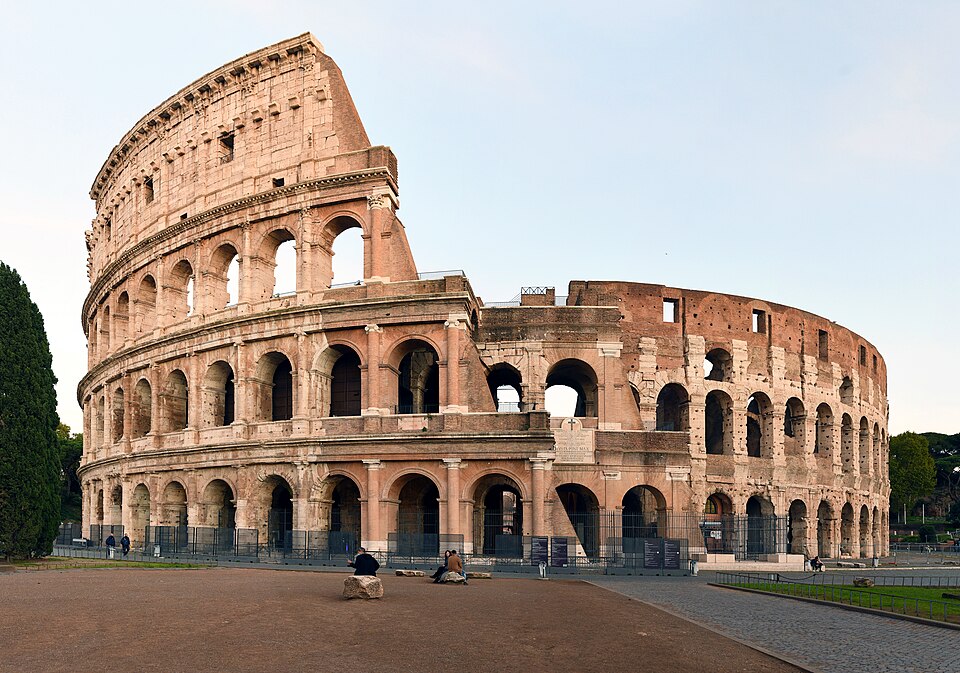
The Colosseum ( KOL-ə-SEE-əm; Italian: Colosseo [kolosˈsɛːo]) is an elliptical amphitheatre in the centre of the city of Rome, Italy, just east of the Roman Forum. It is the largest ancient amphitheatre ever built, and is the largest standing amphitheatre in the world. Construction began under the Emperor Vespasian (r. 69-79 AD) in 72 and was completed in AD 80 under his successor and heir, Titus (r. 79-81). Further modifications were made during the reign of Domitian (r. 81-96). The three emperors who were patrons of the work are known as the Flavian dynasty, and the amphitheatre was named the Flavian Amphitheatre (Latin: Amphitheatrum Flavium; Italian: Anfiteatro Flavio [aɱfiteˈaːtro ˈflaːvjo]) by later classicists and archaeologists for its association with their family name (Flavius).
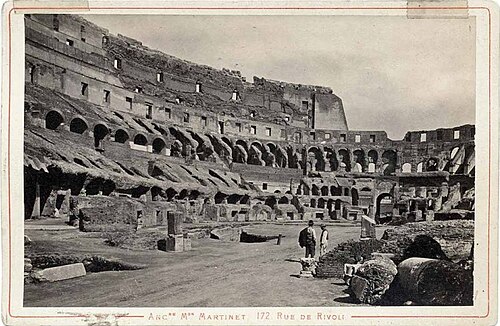
The Colosseum is built of travertine, Roman concrete (foundations, corridors vaults and secondary brick walls), and tuff (volcanic rock). It could hold an estimated 50,000 to 80,000 spectators at various points in its history, having an average audience of some 65,000; it was used for gladiatorial contests and public spectacles including animal hunts, executions, re-enactments of famous battles, dramas based on Roman mythology, and briefly mock sea battles. The building ceased to be used for entertainment in the early medieval era. It was later reused for such purposes as housing, workshops, quarters for a religious order, a fortress, a quarry, and a Christian shrine.
Further reading
Colosseum is one of the 3D puzzles in World Artifacts: turn a cloud of broken pieces until it lines up. For iPhone, iPad, Apple Vision Pro and Android.

