World Artifacts › Atlas › Japan
Akita (Hachiko)
Hachiko went to the station to meet his owner every evening, and kept going for nine years after the man died at work. He is a statue at Shibuya, and also, less comfortably, a stuffed exhibit in the national museum.
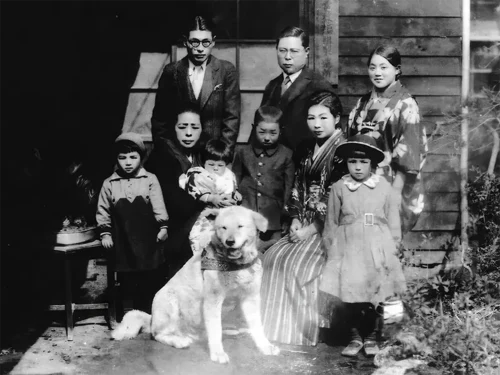
Hachikō (ハチ公; mid-November 1923 - March 8, 1935) was an Akita dog remembered for his strong dedication to his owner, Hidesaburō Ueno, for whom he continued to wait for almost ten years following Ueno's death in 1925.
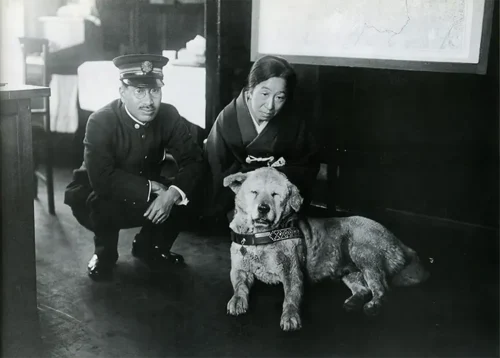
Hachikō was born in mid-November 1923, on a farm near Ōdate, Akita Prefecture, Japan. In 1924, Hidesaburō Ueno, a professor at the Tokyo Imperial University, brought him to live in Shibuya, Tokyo, as his pet. Hachikō met Ueno at Shibuya Station every day after his commute home. This continued until May 21, 1925, when Ueno died of a cerebral aneurysm infarction while at work. From then until his death on March 8, 1935, Hachikō returned to Shibuya Station almost every day to await Ueno's return.
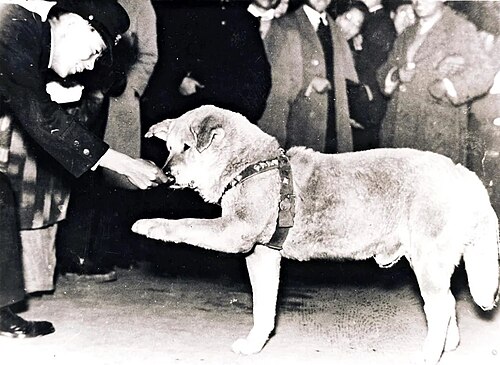
According to some contemporary accounts, Hachikō faced neglect and occasional mistreatment at Shibuya Station after Ueno's death, but was undeterred from visiting. Once his story became nationally known, his remarkable display of loyalty was widely reported in Japanese media, and public interest grew significantly. After he became known internationally, his story led Helen Keller to bring the first Akita to America. Since his death, he continues to be remembered worldwide in popular culture with statues, movies, and books of him.
Further reading
- Empire of Dogs · Aaron Skabelund (2019)Covers dogs and imperialism in Japan, in a history of dogs in modern Japanese society.Find a copy: AbeBooks · Amazon · WorldCat
- Akita, treasure of Japan · Barbara Bouyet (1992)A book on the Akita dog breed as a Japanese treasure.Find a copy: AbeBooks · Amazon · WorldCat
Akita (Hachiko) is one of the 3D puzzles in World Artifacts: turn a cloud of broken pieces until it lines up. For iPhone, iPad, Apple Vision Pro and Android.

