World Artifacts › Atlas ›
Torii Gate
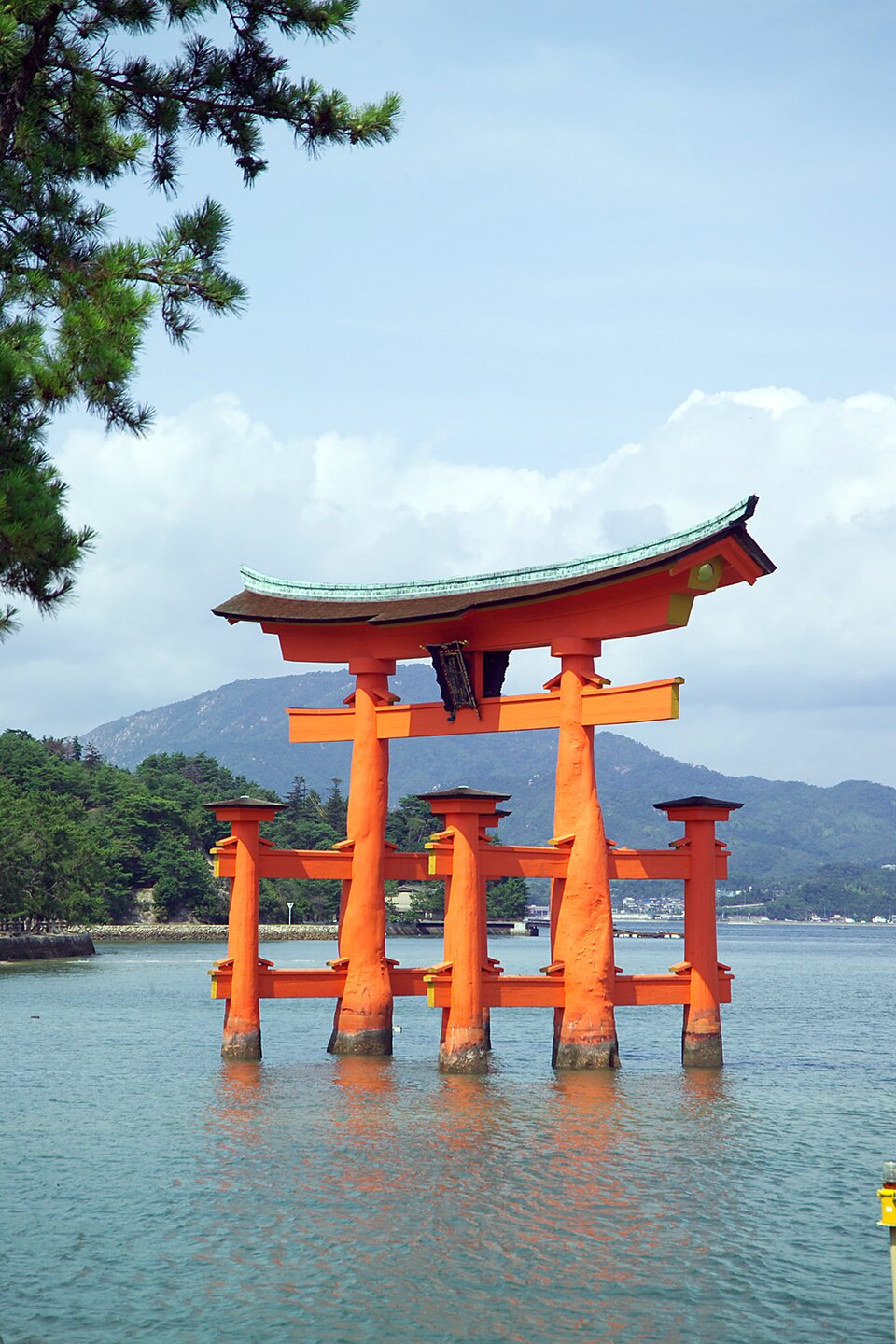
A torii (Japanese: 鳥居; [to.ɾi.i]) is a traditional Japanese gate most commonly found at the entrance of, or within, a Shinto shrine, where it symbolically marks the transition from the mundane to the sacred, and a spot where kami are welcomed and thought to travel through.
The presence of a torii at the entrance is usually the simplest way to identify a Shinto shrine, and a small torii-shaped icon is used to represent shrines on Japanese maps.
The first appearance of torii gates in Japan can be reliably pinpointed to at least the mid-Heian period; they are mentioned in a text written in 922. The oldest extant stone torii was built in the 12th century and belongs to a Hachiman shrine in Yamagata Prefecture. The oldest extant wooden torii is a ryōbu torii at Kubō Hachiman Shrine in Yamanashi Prefecture built in 1535.
Torii gates were traditionally made from wood or stone, but today they can be also made of reinforced concrete, stainless steel and other materials. They are usually either unpainted or painted vermilion with a black upper lintel. Shrines of Inari, the kami of fertility and industry, typically have many torii because those who have been successful in business often donate torii in gratitude. Fushimi Inari-taisha in Kyoto has thousands of such torii, each bearing the donor's name.
Further reading
- A popular dictionary of Shinto · Brian Bocking (1997)A dictionary of Shinto terms and concepts.Find a copy: AbeBooks · Amazon · WorldCat
- Shinto art: Ise and Izumo shrines · Yasutada Watanabe (1974)Covers Shinto shrine architecture at the Ise and Izumo shrines.Find a copy: AbeBooks · Amazon · WorldCat
Torii Gate is one of the 3D puzzles in World Artifacts: turn a cloud of broken pieces until it lines up. For iPhone, iPad, Apple Vision Pro and Android.

