World Artifacts › Atlas › Kenya
Nyatiti
The nyatiti is an eight-string lyre played by the Luo, and the player wears a metal ring on the toe to strike the body of the instrument for percussion, so one person is a band. The songs are current events as much as tradition.
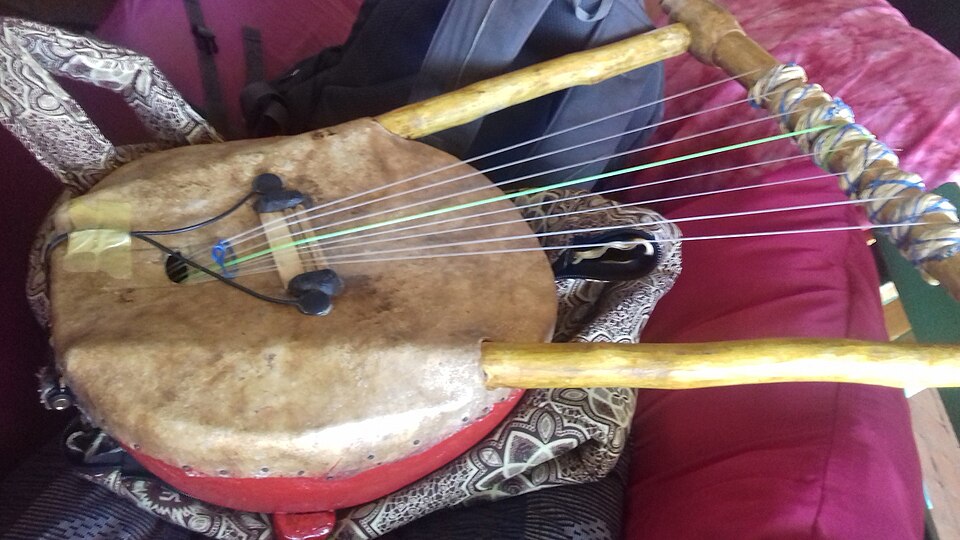
The nyatiti is a five to eight-stringed plucked bowl yoke lute from Kenya. It is a classical instrument played by the Luo people of Western Kenya, specifically in the Siaya region north of Kisumu. It is about two to three feet long with a bowl-shaped, carved wood resonator covered in cow skin. Historically, strings were fashioned from cattle tendons, but modern players almost exclusively use nylon and plastic fishing line of various sizes, a move which changed the sound of the nyatiti drastically.
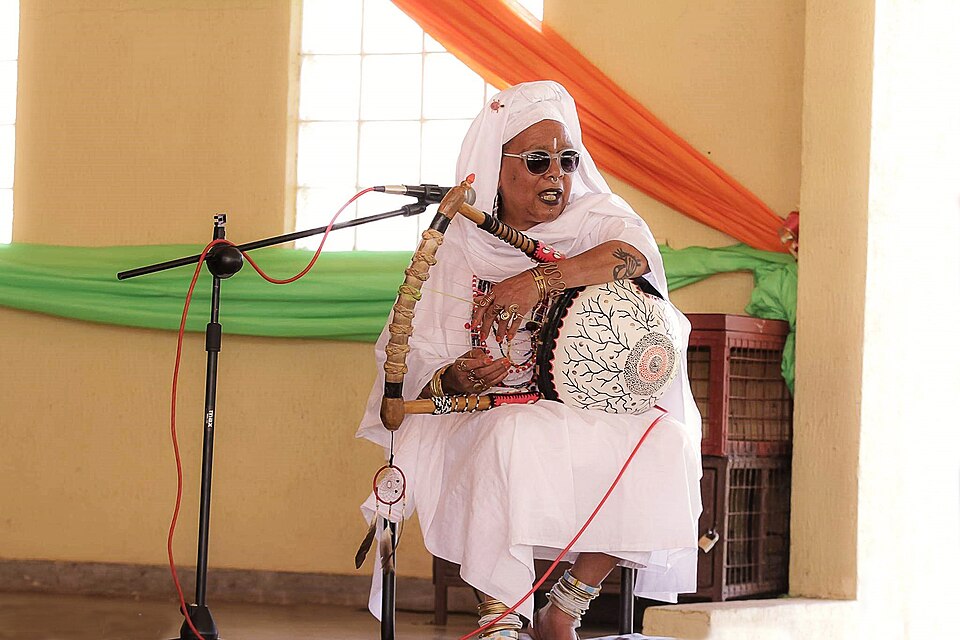
The nyatiti as played in Kenya usually has eight strings. Though the register will vary to match a comfortable singing range of the player, a typical tuning will be, from top to bottom, B-A-G#-E-E-D-B-A, where the outside strings are the same note at the same pitch, and the middle two are an octave apart. Many modern players use individual tunings to match their particular musical style. The most common playing style uses the thumb and middle finger of both hands, alternating between the two to create a rhythmic and circular musical pattern.
If played in a traditional style, the performer sits on a short, shin level chair called the orindi. The player wears a wrought iron ring called the oduong'o around the big toe of the right foot and the gara, a set of metal bells also on the right leg. With the gara and the oduong'o, the player maintains a constant beat, banging the iron ring on the bottom bar of the nyatiti.
Nyatiti is one of the 3D puzzles in World Artifacts: turn a cloud of broken pieces until it lines up. For iPhone, iPad, Apple Vision Pro and Android.

