World Artifacts › Atlas › South Korea
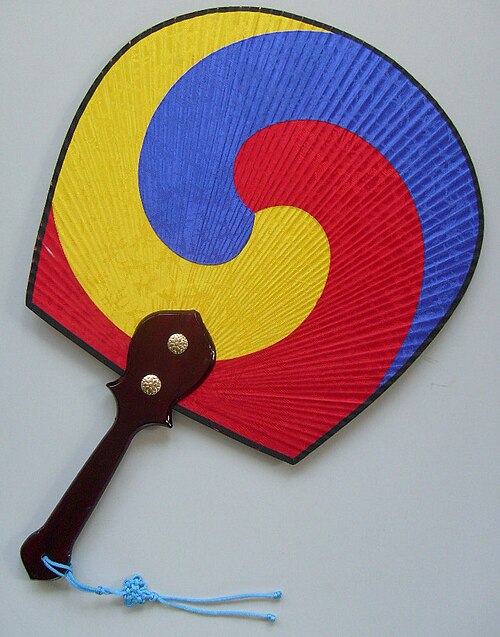
Taegeuk Fan
The red and blue swirl on the fan is the same taegeuk that sits on the flag: two forces that make up everything by opposing each other. Fans are still handed out by the tens of thousands at Korean political rallies, printed on both sides.
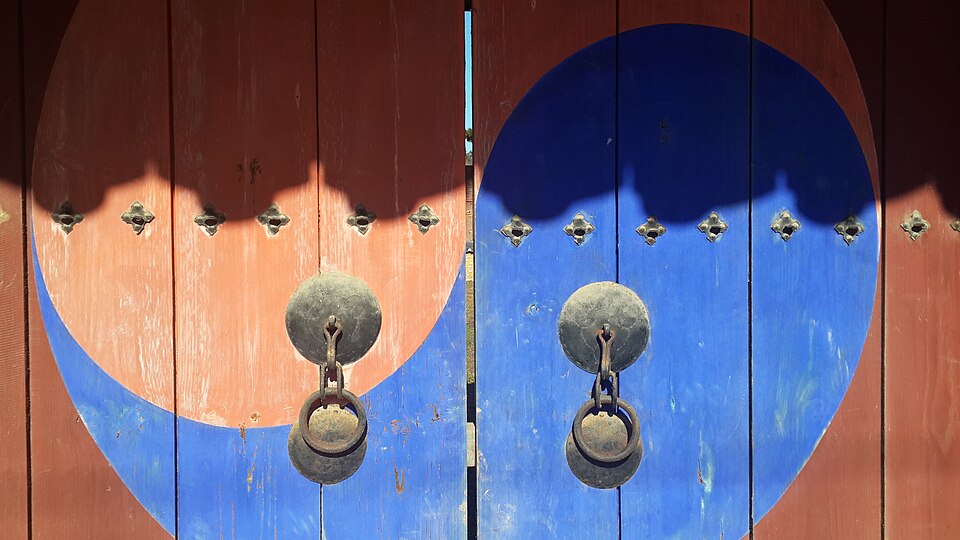
Taegeuk (Korean: 태극; Hanja: 太極, Korean pronunciation: [tʰɛgɯk̚]) is a Sino-Korean term meaning "supreme ultimate", although it can also be translated as "great polarity / duality / extremes". The term and its overall concept is derived from the Chinese Taiji, popularised in the west as the yin and yang. The symbol was chosen for the design of the Korean national flag in the 1880s. It substitutes the black and white color scheme often seen in most taijitu illustrations with blue and red, respectively, along with a horizontal separator, as opposed to vertical.
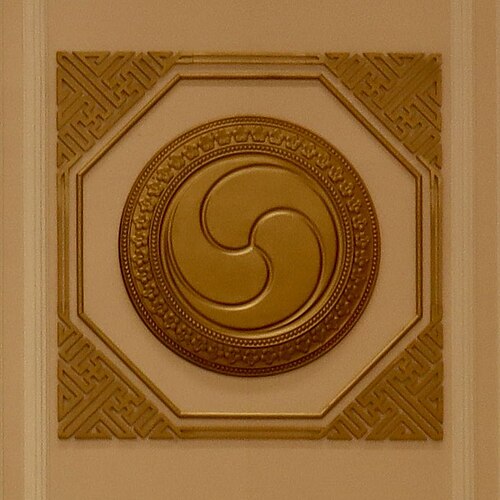
South Koreans commonly refer to their national flag as Taegeukgi (태극기), where gi (기) means "flag" or "banner". This particular color-themed taegeuk symbol is typically associated with Korean traditions and represents balance in the universe; the red half represents positive cosmic forces, and the blue half represents the complementary or opposing, negative cosmic forces. It is also used in Korean shamanism, Confucianism, Taoism, and Buddhism.
Further reading
Taegeuk Fan is one of the 3D puzzles in World Artifacts: turn a cloud of broken pieces until it lines up. For iPhone, iPad, Apple Vision Pro and Android.

