World Artifacts › Atlas › New Zealand
Pohutu Geyser
The geyser fires several times a day to about twenty metres and is the largest in the southern hemisphere. The town around it smells of sulphur, has geothermal steam coming up through drains and gardens, and heats its buildings with it.
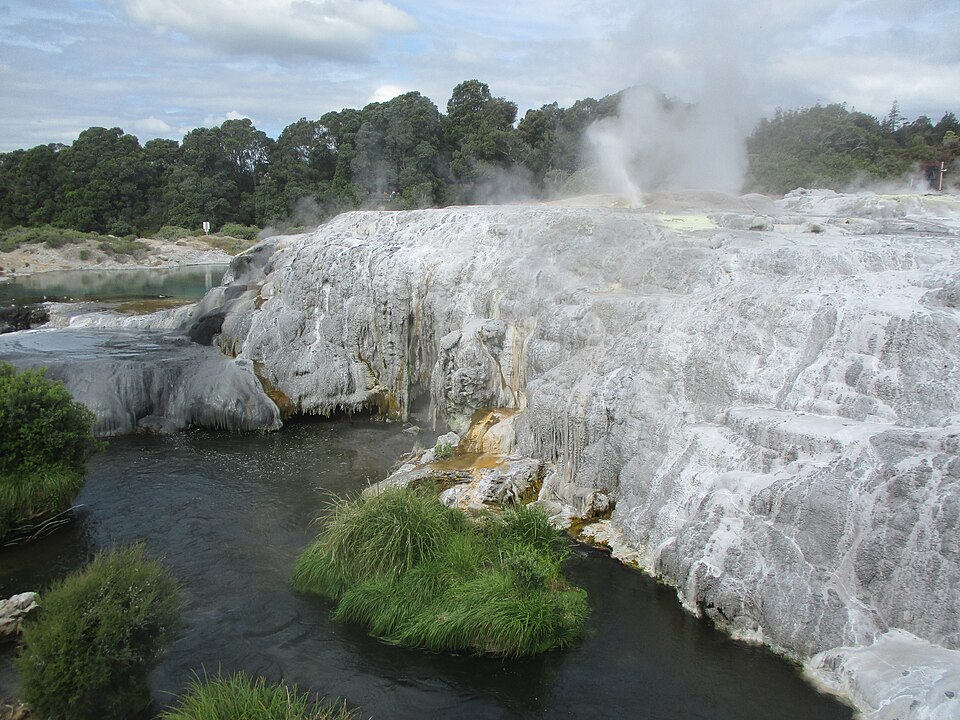
Pōhutu Geyser is a geyser in the Whakarewarewa Thermal Valley, Rotorua, in the North Island of New Zealand. The geyser is the largest in the southern hemisphere and among the most active in the area, erupting up to twenty times per day at heights of up to 30 m (98 ft). The name Pōhutu is derived from te reo Māori, although it has an unclear etymology - being translated as either 'big splash', 'explosion' or 'constant splashing'.
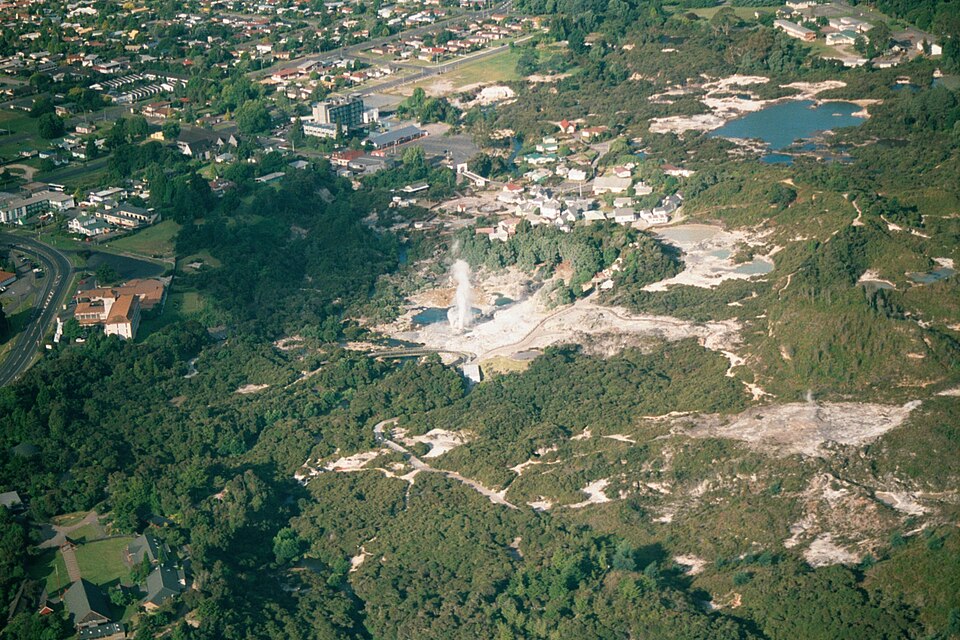
The use of geothermal bores for heating by nearby Rotorua has impacted on the activity of Pōhutu Geyser and other nearby geothermal features. After a decline in geothermal activity at Whakarewarewa, a programme in the late 1980s saw bores within 1.5 km (0.93 mi) of the geyser being shut, leading to a pronounced increase in activity. This activity increase has concerned some scientists who have been involved with the field, who claim that the increased regularity of Pōhutu Geyser's eruptions may result in the system dying in the future. Its crater is 50 cm (20 in) in diameter.
Further reading
- The founding years in Rotorua · D. M. Stafford (1986)A history of the early years of Rotorua, the town beside the geyser.Find a copy: AbeBooks · Amazon · WorldCat
- Te Arawa · Don Stafford (2016)A history of the Te Arawa Maori people, the tribal setting of the Rotorua area.Find a copy: AbeBooks · Amazon · WorldCat
Pohutu Geyser is one of the 3D puzzles in World Artifacts: turn a cloud of broken pieces until it lines up. For iPhone, iPad, Apple Vision Pro and Android.

