World Artifacts › Atlas › Romania
Sturgeon
The long-snouted Danube sturgeon.
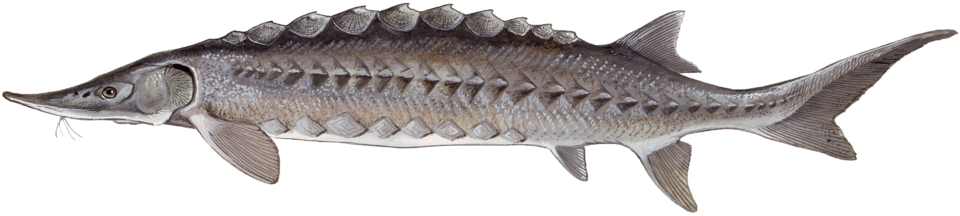
Sturgeon are the 27 species of fish belonging to the family Acipenseridae. The earliest sturgeon fossils date to the Late Cretaceous, and are descended from other, earlier acipenseriform fish, which date back to the Early Jurassic period, some 174 to 201 million years ago. They are one of two living families of the Acipenseriformes alongside paddlefish (Polyodontidae). Sturgeons are native to subtropical, temperate and sub-Arctic rivers, lakes and coastlines of Eurasia and North America. Sturgeons are long-lived, late-maturing fishes with distinctive characteristics, such as a heterocercal caudal fin similar to those of sharks, and an elongated, spindle-like body that is smooth-skinned, scaleless, and armored with five lateral rows of bony plates called scutes.
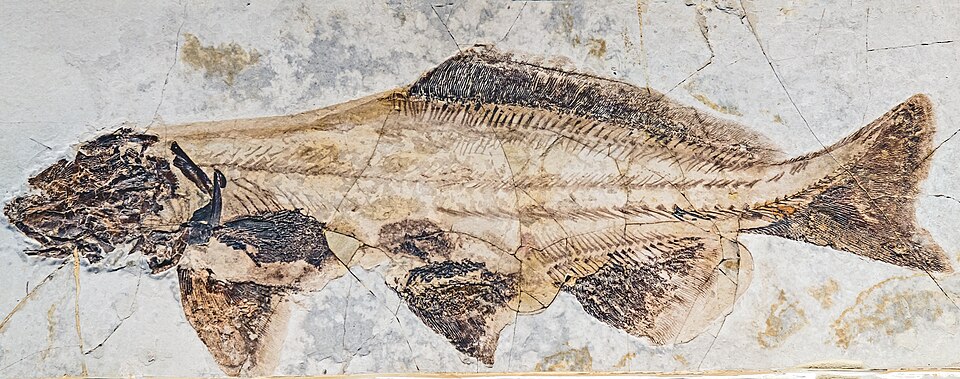
Several species can grow quite large, typically ranging 2-3.5 m (7-12 ft) in length. The largest sturgeon on record was a beluga female captured in the Volga Delta in 1827, measuring 7.2 m (23 ft 7 in) long and weighing 1,571 kg (3,463 lb). The family is grouped into five genera: Acipenser, Huso, Scaphirhynchus, Sinosturio, and Pseudoscaphirhynchus. One species (S. dabryanus) may be extinct in the wild, and another (P. fedtschenkoi) may be entirely extinct. Beginning in 2011 H. naccarii was presumed extinct in the wild, but in 2022 was downgraded to critically endangered. A Maastrichtian-age fossil found in Morocco shows that they also once lived in northern Africa during the Cretaceous.
Further reading
Sturgeon is one of the 3D puzzles in World Artifacts: turn a cloud of broken pieces until it lines up. For iPhone, iPad, Apple Vision Pro and Android.

