World Artifacts › Atlas › Thailand
Hanuman (Ramakien)
The Thai Hanuman is not the celibate devotee of the Indian epic. In the Thai version he is a womaniser and a show-off, which the audience enjoys, and his colour is white rather than the Indian orange.
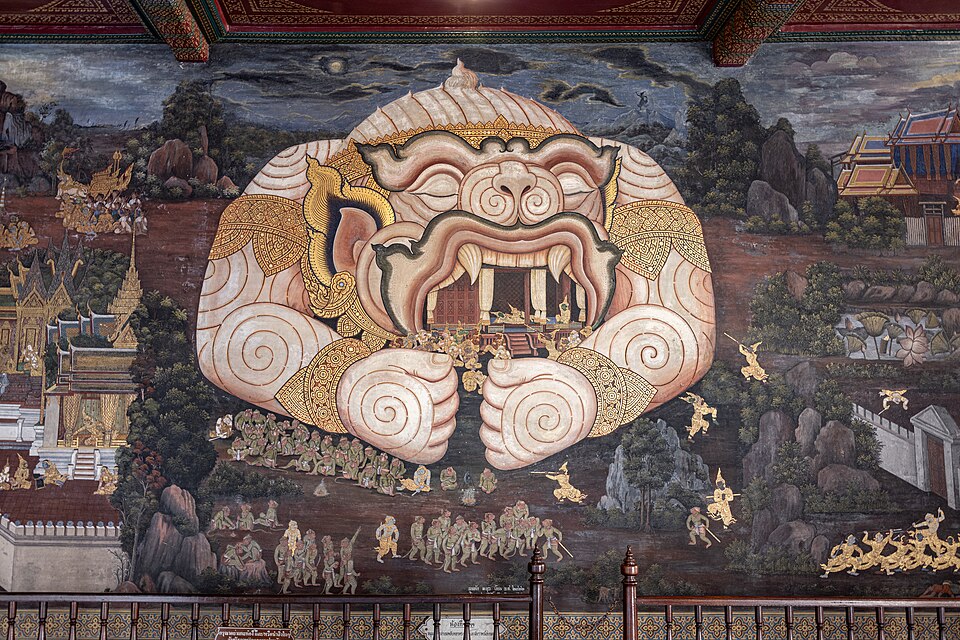
The Ramakien (Thai: รามเกียรติ์, RTGS: Rammakian, pronounced [rāːm.mā.kīa̯n]; lit. 'Glory of Rama'; sometimes also spelled Ramakian) is one of Thailand's national epics. It is a Thai version of the ancient Indian Hindu epic Ramayana, and an important part of the Thai literary canon.
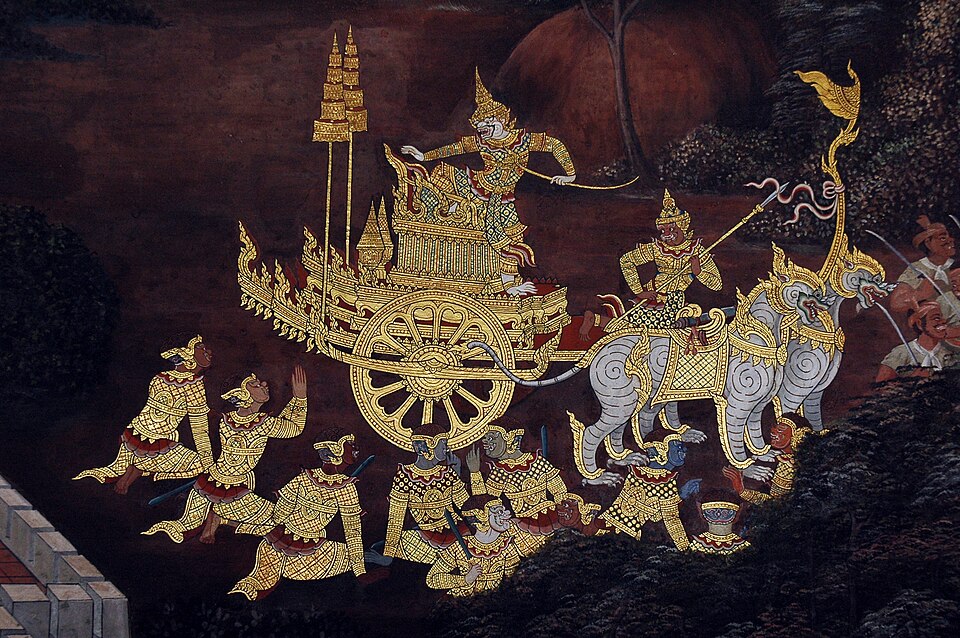
King Rama VI (r. 1910 - 1925) was the first person to shed light first on the Ramayana studies in Thailand, by tracing the sources of the Ramakien, comparing it with the Sanskrit Valmiki Ramayana. He found that the Ramakien was influenced by three sources: the Valmiki's Ramayana, the Vishnu Purana, and Hanuman Nataka. A number of versions of the epic were lost in the destruction of Ayutthaya in 1767. Three versions currently exist, one of which was prepared in 1797 under the supervision of (and partly written by) King Rama I. His son, Rama II, rewrote some parts of his father's version for khon drama. The work has had an important influence on Thai literature, art and drama (both the khon and nang dramas being derived from it).
Further reading
Hanuman (Ramakien) is one of the 3D puzzles in World Artifacts: turn a cloud of broken pieces until it lines up. For iPhone, iPad, Apple Vision Pro and Android.

