World Artifacts › Atlas › Turkey
Hagia Sophia
Hagia Sophia was a church for 916 years, a mosque for 481, a museum for 86, and a mosque again since 2020. Its first dome fell in an earthquake twenty years after it was built and the replacement was made steeper.
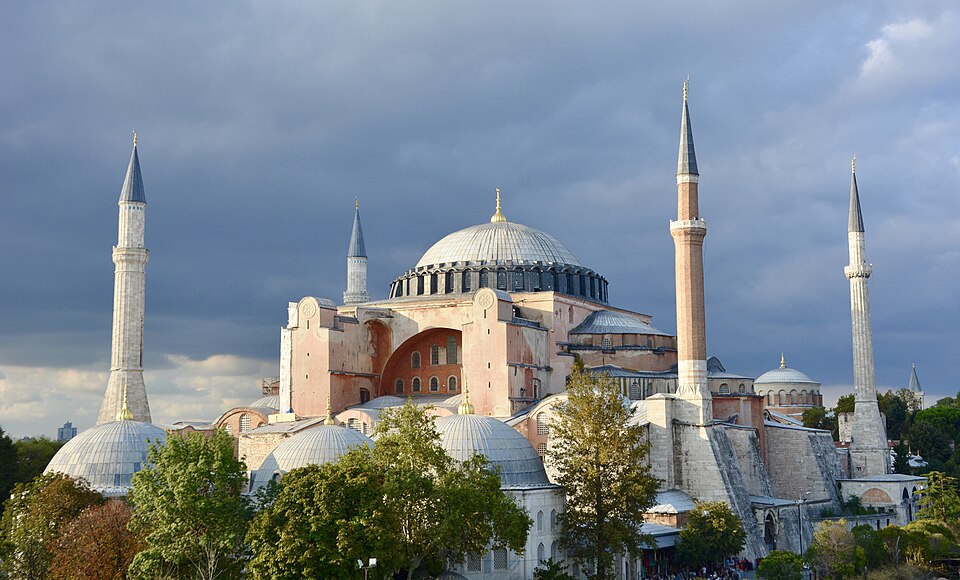
Hagia Sophia, officially the Hagia Sophia Grand Mosque, is a mosque and a major cultural and historical site in Istanbul, Turkey. It was formerly a church (360-1453) and a museum (1935-2020). The last of three church buildings to be successively erected on the site by the Eastern Roman Empire, it was completed in AD 537, becoming the world's largest interior space and among the first to employ a fully pendentive dome. It is considered the epitome of Byzantine architecture and is said to have "changed the history of architecture". From its dedication in 360 until 1453, Hagia Sophia served as the cathedral of Constantinople in the Byzantine liturgical tradition, except for the period 1204-1261 when the Latin Crusaders installed their own hierarchy. After the fall of Constantinople in 1453, it served as a mosque, having its minarets added soon after. The site became a museum in 1935, and was redesignated as a mosque in 2020.
Further reading
- Hagia Sophia · Rowland Mainstone (1988)A study of Hagia Sophia's architecture, covering Byzantine building and the church's liturgy and structure.Find a copy: AbeBooks · Amazon · WorldCat
- Hagia Sophia · Lord & the Editors of the Newsweek Book Division Kinross (1973)A book devoted to Hagia Sophia, from the Newsweek Book Division series.Find a copy: AbeBooks · Amazon · WorldCat
Hagia Sophia is one of the 3D puzzles in World Artifacts: turn a cloud of broken pieces until it lines up. For iPhone, iPad, Apple Vision Pro and Android.

