World Artifacts › Atlas › Turkey
Library of Celsus
The library was built as a tomb: the man it honours is buried in a vault underneath his own reading room. The facade is a trick, with the middle columns taller and the base slightly curved, so that it looks larger than it is.
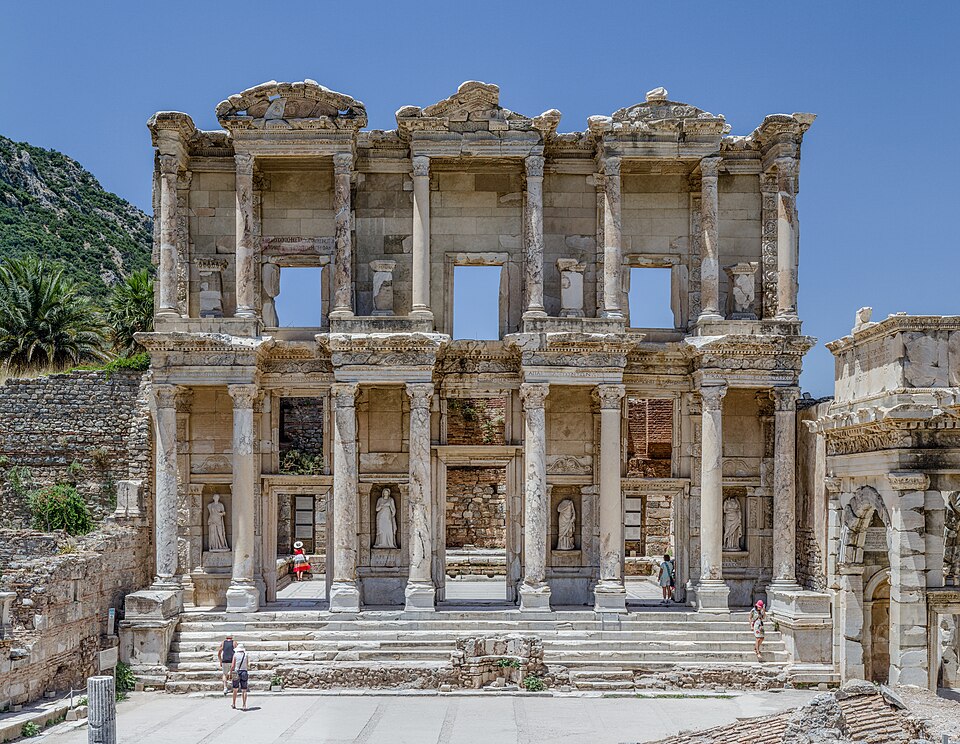
The Library of Celsus (Greek: Βιβλιοθήκη του Κέλσου) is an ancient Roman building in Ephesus, Anatolia, located near the modern town of Selçuk, in the İzmir Province of western Turkey. The building was commissioned in the years 110s CE by a consul of the Roman Empire, Tiberius Julius Aquila Polemaeanus, as a funerary monument for his father Tiberius Julius Celsus Polemaeanus, former proconsul of Asia, and completed during the reign of the Roman Emperor Hadrian, sometime after Aquila's death.

The Library of Celsus is considered an architectural marvel, and is one of the few remaining examples of great libraries of the ancient world located in the Roman Empire. It was the third-largest library in the Greco-Roman world behind only those of Alexandria and Pergamum, and is believed to have held around 12,000 scrolls. Celsus is buried in a crypt beneath the library in a decorated marble sarcophagus. The interior measured roughly 180 square metres (2,000 square feet).

The interior of the library and its contents were destroyed in a fire that resulted either from an earthquake or a Gothic invasion in 262 CE, and the façade by an earthquake in the 10th or 11th century. It lay in ruins for centuries until the façade was re-erected by archaeologists between 1970 and 1978.
Further reading
- Libraries in the Ancient World · Lionel Casson (2002)Surveys libraries of the ancient world, giving the history and setting for a Roman library like this one.Find a copy: AbeBooks · Amazon · WorldCat
- The origin and evolution of architectural form of Roman library · Elżbieta Makowiecka (1978)Studies the origins and development of Roman library architecture.Find a copy: AbeBooks · Amazon · WorldCat
Library of Celsus is one of the 3D puzzles in World Artifacts: turn a cloud of broken pieces until it lines up. For iPhone, iPad, Apple Vision Pro and Android.

