World Artifacts › Atlas › Turkey
Nazar Boncuğu
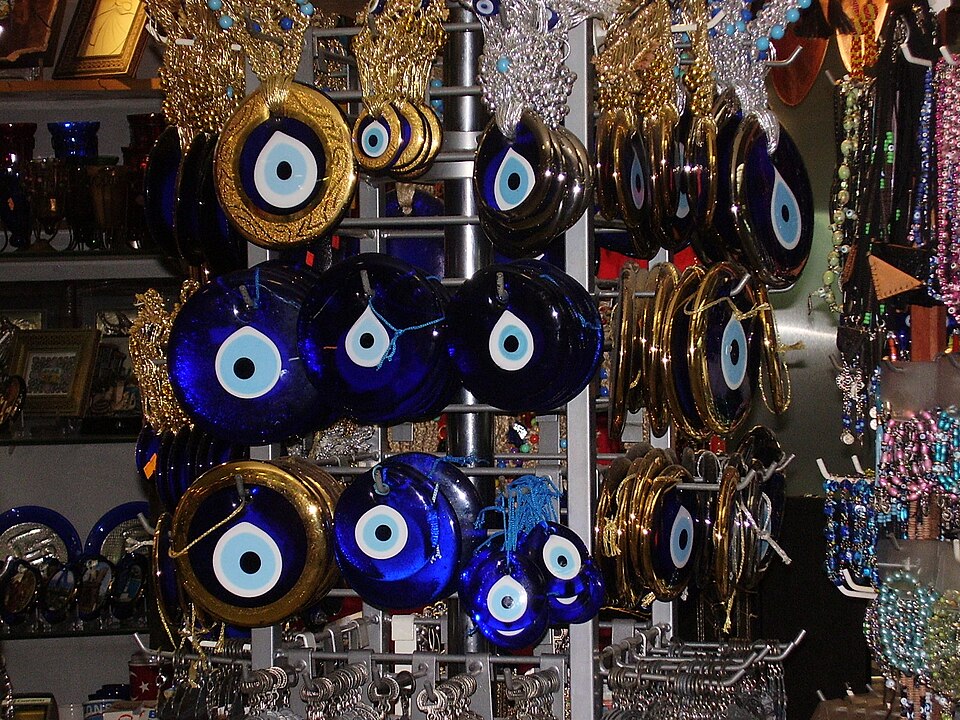
The eye bead is made in wood-fired furnaces where the glass is worked by hand, mostly around İzmir. Blue is used because blue eyes were rare here and so were thought more likely to carry envy.
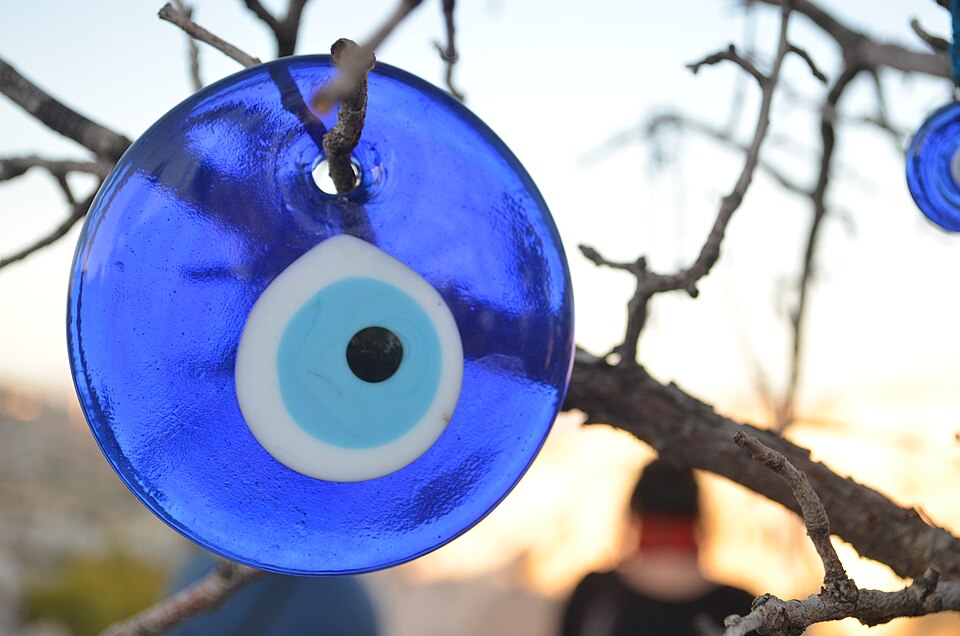
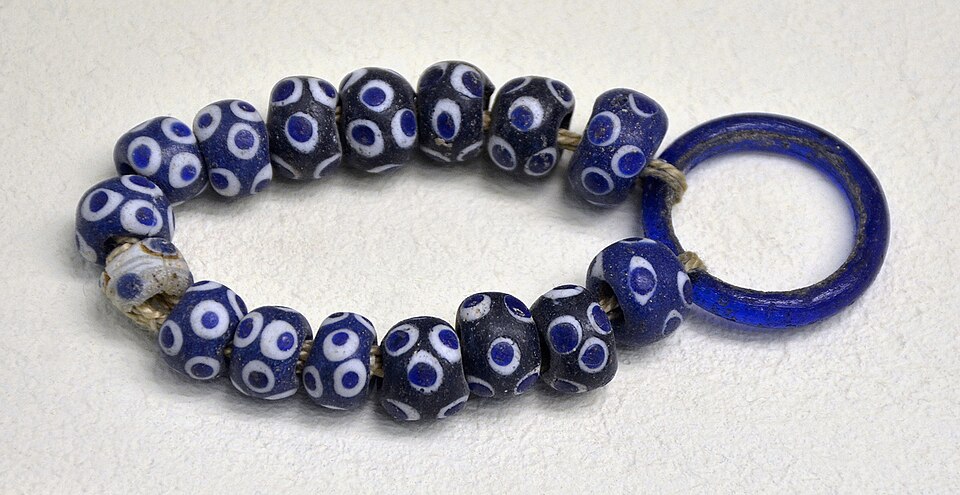
A naẓar (from Arabic نَظَر [ˈnaðˤar], meaning 'sight', 'surveillance', 'attention', and other related concepts), or an eye bead, is an eye-shaped amulet believed to protect against the evil eye. The term is also used in Albanian, Azerbaijani, Bengali, Hebrew, Hindi-Urdu, Kurdish, Pashto, Persian, Punjabi, Sindhi, Turkish, and other languages. In Turkey, it is known by the name nazar boncuğu (the latter word being a derivative of boncuk, "bead" in Turkic, and the former borrowed from Arabic), in Greece it is known as máti (μάτι, 'eye'). In Persian and Afghan folklore, it is called a cheshm nazar (Persian: چشم نظر) or nazar qurbāni (نظرقربانی). In India and Pakistan, the Hindi-Urdu slogan chashm-e-baddoor (چشم بدور, '[may the evil] eye keep away') is used to ward off the evil eye. In the Indian subcontinent, the phrase nazar lag gai is used to indicate that one has been affected by the evil eye.
The nazar was added to Unicode as U+1F9FF 🧿 NAZAR AMULET in 2018.
Further reading
Nazar Boncuğu is one of the 3D puzzles in World Artifacts: turn a cloud of broken pieces until it lines up. For iPhone, iPad, Apple Vision Pro and Android.

