World Artifacts › Atlas › Turkey
Rumi
Rumi wrote in Persian, not Turkish, lived most of his life in Konya and is buried there. He described the night he died as his wedding night, meaning the union with God, and the anniversary is still marked as a celebration rather than a mourning.
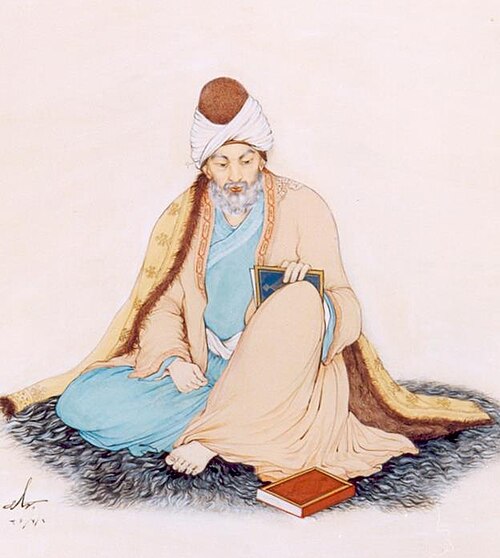
Jalāl al-Dīn Muḥammad Balkhī (30 September 1207 - 17 December 1273), commonly known as Rumi, was a Sufi mystic, poet, and founder of the Islamic brotherhood known as the Mevlevi Order. His family hailed from Balkh. Rumi is an influential figure in Sufism, and his thought and works loom large both in Persian literature and mystic poetry in general. Today, his translated works are enjoyed all over the world.
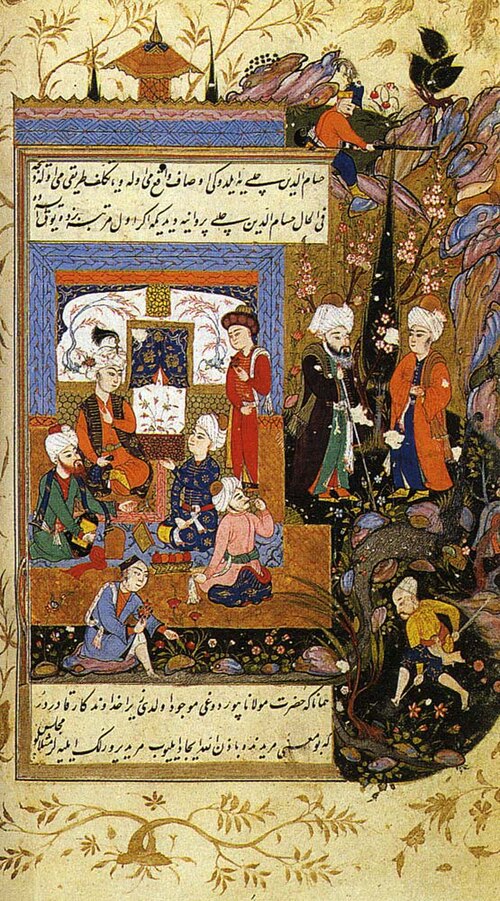
The rapidly advancing Mongol hordes forced his family to flee west early on in his life. After spending time in various cities across Iran, Baghdad, and Damascus, he settled in Konya with his family at age 19. Until recently, Konya had been a province of the Eastern Roman Empire, hence his name, Rumi, i.e. "the Roman". Although he was exposed to Sufi thought from his early childhood, he was expected to follow his fathers footsteps as an Islamic scholar.

However, the arrival to Konya of the mysterious wandering dervish, Shams Tabrīzī, would alter the course of his life permanently. Rumi and Shams became infatuated with each other, causing Rumi to neglect his duties. When Shams mysteriously disappeared, Rumi experienced an intense period of grief reflected in his Divan of Shams Tabrīzī. This was the defining moment in the evolution of Rumi's spiritual worldview, and marked the beginning of his poetic output.
Further reading
- Rumi--Past and Present, East and West · Franklin D. Lewis (2004)A biography of Rumi covering his life and legacy, East and West.Find a copy: AbeBooks · Amazon · WorldCat
- Selected poems of Rūmī · Rumi (Jalāl ad-Dīn Muḥammad Balkhī) (2001)English translations of selected poems by Rumi, in the Persian Sufi poetry tradition.Find a copy: AbeBooks · Amazon · WorldCat
Rumi is one of the 3D puzzles in World Artifacts: turn a cloud of broken pieces until it lines up. For iPhone, iPad, Apple Vision Pro and Android.

