World Artifacts › Atlas › Tanzania
Wildebeest Migration
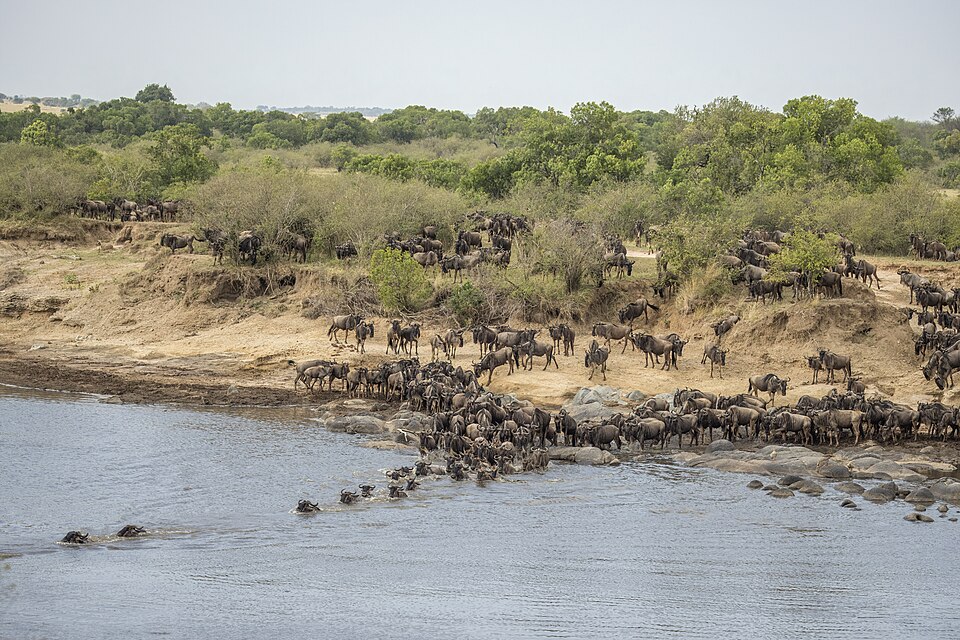
Around two million wildebeest and zebra move in a loop through the Serengeti and Mara, and the calving happens on the southern short-grass plains because volcanic ash makes the grass there rich in the minerals a nursing female needs. About half a million calves are born in a few weeks.
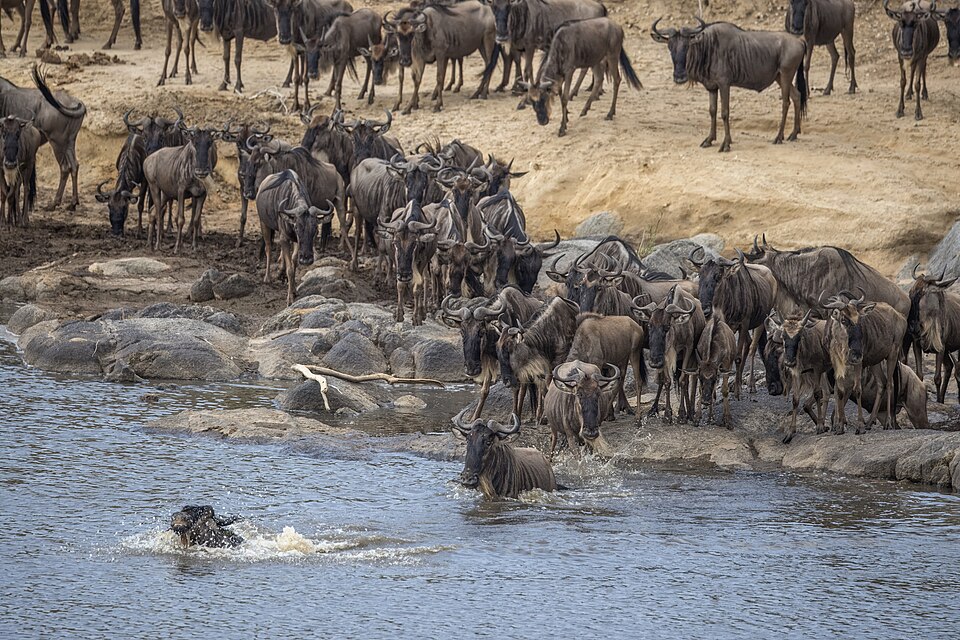
The blue wildebeest (Connochaetes taurinus), also called the common wildebeest, white-bearded gnu or brindled gnu, is a large antelope and one of the two species of wildebeest. It is placed in the genus Connochaetes and family Bovidae, and has a close taxonomic relationship with the black wildebeest. The blue wildebeest is known to have five subspecies. This broad-shouldered antelope has a muscular, front-heavy appearance, with a distinctive, robust muzzle. Young blue wildebeest are born tawny brown, and begin to take on their adult coloration at the age of 2 months. The adults' hues range from a deep slate or bluish-gray to light gray or even grayish-brown. Both sexes possess a pair of large curved horns.
Further reading
- Serengeti · Mitsuaki Iwago (1987)Photographic book on the animals of the Serengeti.Find a copy: AbeBooks · Amazon · WorldCat
- The Kingdon field guide to African mammals · Jonathan Kingdon (2003)Field guide to identifying African mammals, with pictorial coverage.Find a copy: AbeBooks · Amazon · WorldCat
Wildebeest Migration is one of the 3D puzzles in World Artifacts: turn a cloud of broken pieces until it lines up. For iPhone, iPad, Apple Vision Pro and Android.

